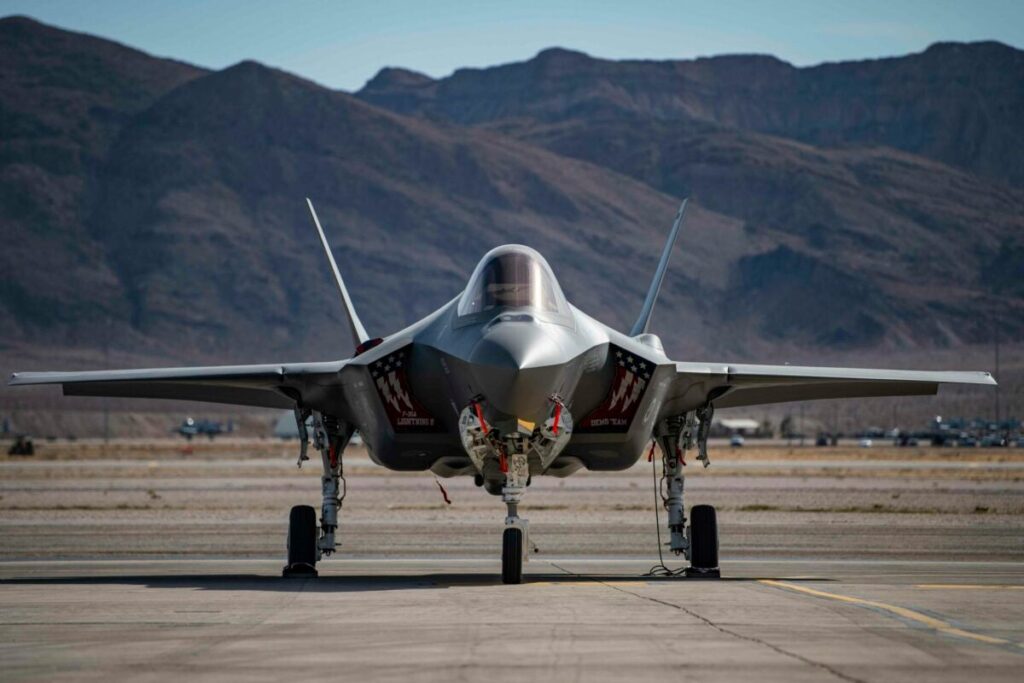
More than 150 aircraft took part in the U.S. attack on Venezuela on Saturday, including some reportedly deployed for the first time or in novel situations.
The mission, code-named Operation Absolute Resolve, saw fighters and bombers strike communications infrastructure and military sites while Venezuelan President Nicolás Maduro and his wife, Cilia Flores, were arrested at their compound in Caracas. The two were taken on board the USS Iwo Jima before being flown to New York.
In the days since, officials in the Trump administration and the military have described a highly complex operation featuring some of the most powerful and advanced aerial systems in the nation’s arsenal.
At a news conference, General Dan Caine, chairman of the Joint Chiefs of Staff, said helicopters carrying military and law enforcement personnel were sent into downtown Caracas to seize Maduro and his wife. Protecting the “interdiction” group and assets on the ground was a force including F-22s, F-35s, F/A-18s, EA-18s, E-2s, B-1 bombers, support aircraft, and “numerous” remotely piloted drones.
The aircraft were provided by the U.S. Air Force, Marines, Navy, and Air National Guard, Caine said. The youngest crew member involved in the assault was 20, Caine said, and the oldest 49.
The bombers are believed to have struck sensitive military locations like Generalissimo Francisco de Miranda Air Base and Fort Tiuna, both in the Caracas area.

The E-2 is a surveillance and early warning aircraft, and the EA-18 is designed for electronic warfare. Both likely played a role in monitoring and then disrupting Venezuelan communications and air defense systems as the attack got underway.
U.S. Space Command and Cyber Command assisted in that aspect of the mission, using “layered effects” to defend American aircraft, Caine said. The chairman did not go into detail about those effects, but it is widely reported that large sections of Caracas lost power during the attack.
One aircraft was hit by enemy fire during the raid but remained flyable, Caine added.
Also Spotted
Media outlets and aviation experts have attempted to identify other aircraft potentially involved in the operation but not specifically named by the military.
Based on videos of the nighttime raid, military news website The War Zone reported that the Direct Action Penetrator (DAP) version of the UH-60 Black Hawk helicopter was used in the extraction. The rotorcraft is known to be operated by the 160th Special Operations Aviation Regiment, which transported the U.S. Army’s Delta Force operators to Maduro’s residence.

A brief video shared on social media showed one of the modified Black Hawks opening fire on an unseen ground target.
The RQ-170 Sentinel was also allegedly spotted. A clip circulating on X reportedly shows the uncrewed aircraft landing in Puerto Rico on Saturday, which would align with the timing of the strike on Venezuela.
U.S. RQ-170 stealth drone returning to Puerto Rico this morning.
This is a quiete rare footage of the drone, spotted after supporting US strikes on Venezuela last night.
[
Nando Curbelo Rodriguez]pic.twitter.com/dYVHcfGvbQ
— Massimo (@Rainmaker1973) January 3, 2026
 Nando Curbelo Rodriguez]
The Air Force has released very little information about the RQ-170 since its development.
There is some evidence the U.S. used another, much cheaper kind of drone in Venezuela. The War Zone reported Monday that high-pitched “banshee-like” buzzing captured in videos recorded by Caracas residents could point to kamikaze-style drones, also known as loitering munitions. Ominous wailing, followed by an explosion, has become a sonic signature of one-way drones used in the Russia-Ukraine war.
This would be the first time the U.S. has used kamikaze drones in combat. Washington has been slower to embrace weaponized drones than adversaries like Russia and Iran, though this has changed under the second Trump administration, with a large multi-branch buildup underway.
It is also possible that drones piloted by the CIA were involved in the attack. The New York Times reported that the agency carried out a drone strike on a port in Venezuela in December as part of the White House’s campaign against suspected drug traffickers in the region.
Caine thanked the CIA, together with the NSA, in his remarks to the media. He said the agencies were involved in locating Maduro and studying his security and habits.