
There’s a quiet revolution happening in regional aviation.
William Swelbar, chief industry analyst for Swelbar-Zhong Consultancy, told FLYING that the number of departed seats by regional jet equipment is down nearly 69 percent since 2015, primarily due to lower utilization.
By Swelbar’s estimate, there are about 300 fewer regional aircraft with 50 seats or less flying today than there were a decade ago. But there are about 600 more regional jets with 70-plus seats.
“Given the increases in labor rates that include pilots, mechanics, and flight attendants, the cost per seat of flying 50 seats or less has made utilizing the aircraft on a widespread basis uneconomic,” Swelbar said. “The ability to amortize those costs over 70-76 seats results in much improved economics of flying regional aircraft.”
Swelbar predicted that utilization will soon rise. Michael Derman, chairman and CEO of Canadian manufacturer Evio, believes it could remain high if airlines adopt the company’s solution—hybrid-electric aircraft for up to 100 passengers.
“We found that the market for us really exists in that 50-100-seat space, and the best way to tackle operator economics is with electrification,” Derman told FLYING. “And it makes sense at this point, where the technology is today with batteries, to go with hybrid-electric.”
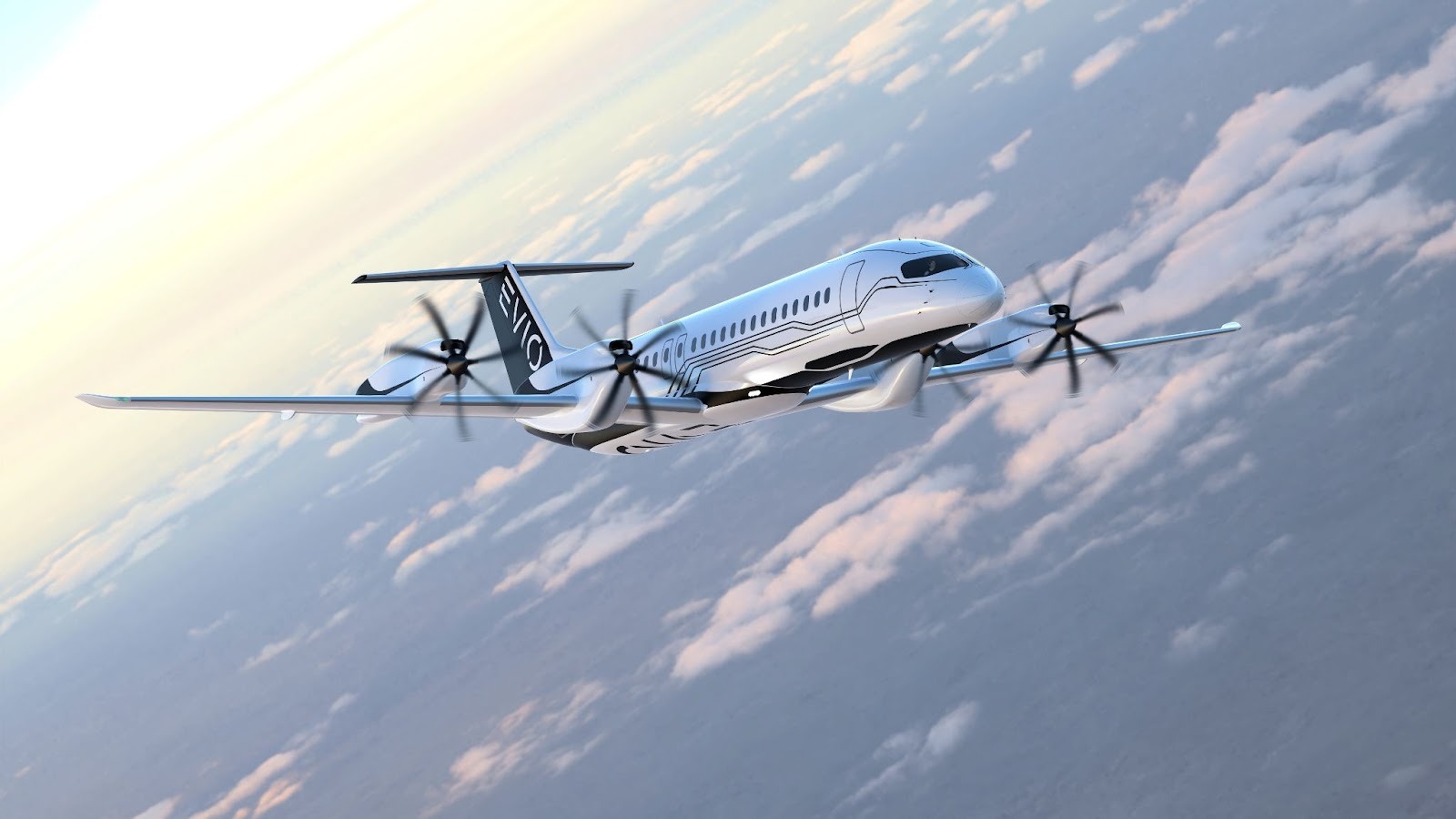
Evio, backed by an undisclosed investment and technical support from Boeing, in December unveiled the Evio 810—a hybrid-electric regional concept that Derman said will be optimized for 200-to-350-mile trips. The “strong hybrid,” as Evio describes it, will use all-electric power for takeoffs, landings, and short flights, switching to hybrid mode for longer routes. Per Derman, those could be 500 nautical miles or longer.
The clean-sheet design will leverage conventional components, such as Pratt & Whitney Canada’s PT6 E-series engine, to create a next-generation propulsion system designed to lower operating and maintenance costs. Evio aims to introduce it in the early 2030s.
“If you’re coming in as a startup, you really have to provide something that materially changes the economics for those operators,” Derman said. “And that’s what we’re tackling, is a material step change in economics.”
Derman said he hopes for Evio to join the ranks of Canada’s legacy aviation titans, from de Havilland to Bombardier and Canadair. Already, the company has signed conditional purchase agreements with a pair of “major airlines” for up to 250 aircraft and a further 200 options.
And it doesn’t plan to confine itself to commercial passenger service. According to Evio, the 810 will be part of a larger family of hybrid-electric models that could one day handle everything from cargo logistics to autonomous military missions such as intelligence, surveillance, and reconnaissance (ISR).
Out of Stealth
Evio unveiled the 810 in December after operating in stealth for about seven years. Derman said the firm waited until the concept design was “locked” in order to show “real engineering rigor” behind the configuration.
“I think that that’s really important, because you only really get one shot to do this right,” he said.
Derman, the former vice president of Sierra Nevada Corporation (SNC), did not take credit for the hybrid-electric concept. That, he said, belongs to co-founder and chief technology officer Luc Van Bavel—a pilot, former F-16 maintenance officer, and independent aircraft designer for more than two decades.
Van Bavel has consulted on the design of single-engine turboprops, very light jets, military trainers, and special mission platforms. His work spans SNC, Bombardier, Diamond Aircraft, and Epic Aircraft’s Victory jet, a 2007 Collier Trophy nominee.
Sitting on Evio’s board is Frank Cappuccio, the former executive vice president of Lockheed Martin and head of the company’s secretive Skunk Works unit from 2001 to 2011. Cappuccio oversaw the company’s successful bid for the U.S. military’s F-35 Joint Strike Fighter procurement program.
Also on the board is former Airbus senior vice president Rob Dewar, who previously led development of the C Series—now the Airbus A220—for Bombardier.
“I just happen to be along for the ride with a great team, and I think that they’re going to do some amazing things for this space,” Derman said.
Go Big or Go Home
Developers of smaller electric aircraft for the general aviation or commuter market began popping up around the time of Evio’s founding. But the Boeing-backed company always wanted to go bigger.
“What we’re trying to do is really help roll out something that improves transportation across the globe,” Derman said.
The larger the aircraft, Derman said, the lower the ratio of battery empty weight to maximum takeoff weight (MTOW). In other words, “if you were to start with purely an all-electric aircraft, it doesn’t matter if it’s six seats or 200 seats,” he said.
“If they’re a similar wing design and a similar battery empty weight fraction of the aircraft, you’re going to go the same amount of miles all-electric, which is about 160 nautical miles,” Derman said. “So you’re actually going to get some efficiencies, whether it’s jet fuel or batteries, to go a little bit more beyond 160 nautical miles.”

The Evio chief relied on his team’s collective brainpower to settle on the company’s strong hybrid concept.
It first explored retrofitting existing aircraft with electric or hybrid systems, or developing a clean-sheet “mild hybrid” that uses electric power only for taxi, takeoff, and climb. But neither option panned out. Nor did hydrogen propulsion, which Evio determined would be too complex and expensive.
“We could never get the economics to pencil out for the operator where it would make financial sense,” Derman said. “What we did realize is that a strong hybrid—where you could go gate to gate, all-electric on your short routes, and then hybrid for those longer routes—provided those economics that were materially equal to or better than existing aircraft.”
That value proposition grabbed the attention of Boeing and Pratt & Whitney Canada, marquee partners that Derman said will mitigate risk for the 810’s Part 25 certification process.
Evio is developing a proprietary fly-by-wire system. But most of the 810’s hardware and software will resemble those on conventional aircraft. The most novel feature is the propulsion system, which will benefit from the integration of Pratt & Whitney’s flight-proven PT6 E-series.
The dual-channel, integrated electronic propeller and engine control system recently surpassed half a million flight hours after five years in service on airframes such as the Pilatus PC-12 NGX and Daher TBM 960. Those are smaller regional turboprops. But Derman said that most of the 810’s power will come from its batteries and electric motors, allowing Evio to use a smaller, less complex turbine.
With few moving parts, the company anticipates infrequent engine inspections and low maintenance costs.
“The E-model variant that’s out now, I mean, it’s got digital controls,” Derman said. “It’s got the latest aerodynamics built into the engine and materials. It’s a very sophisticated, cost-effective, proven technological turbine. Customers are going to really enjoy its predictability, its serviceability.”
Evio’s Niche
Evio projects demand for more than 7,500 regional turboprops and jets over the next two decades. That presents an opportunity to disrupt the market.
“We’ve been studying the regional market for some time, really looking at different ways to bring down the cost of regional flight and restore routes that have been dropped,” Derman said.
The 810 was conceived with regional passengers in mind. For example, Evio is targeting a 76-seat dual class or 88-seat single class Part 25 configuration, typical of Embraer’s E-Jet family. But Derman said the aircraft’s fuselage will be wider than the E175’s.
“If you look at the legacy aircraft turboprop space, you really get to know your neighbor. It’s a very crowded experience. It’s noisy,” he said. “For us, we really needed to take this to a modern experience for the passenger. When they board the aircraft, it’s going to have that modern jetliner, narrowbody experience. The width of the cabin, the width of the aisle, the overhead bins—it’s going to feel like they’re on a modern jetliner.”
The Evio boss added that the use of conventional components will drive down maintenance costs for regional operators. He also emphasized the 810’s low infrastructure demands versus fully electric or vertical takeoff and landing (VTOL) aircraft.
“What we’re providing operators is literally a plug-and-play solution that fits right into their network, how they operate today, how they are able to integrate into the traffic mix flying into a major airport,” Derman said.
He said the company is working with customers and airports to develop charging systems that will leverage standards, “existing know-how, and technology” that have been developed for the trucking industry and some European ferry systems. Power generation will need to be bespoke for every airport that serves the 810. But many are already building infrastructure—such as solar panel farms—to accommodate electric ground vehicles.
“All of this is already happening, and we’re trying to join an initiative that’s already taking place and complement it,” Derman said.
The Evio CEO said the firm is working with airlines to determine initial routes. It is coordinating with local communities, governments, and power generation companies in these locations. Swelbar, though, pointed out that there will be limits on Evio’s scale.
“The number of large regional aircraft in the U.S. being deployed by American, Delta, United, and Alaska are limited by scope clauses contained in mainline pilot contracts,” he said. “Therefore, the regional sector of the business is not expected to grow much over the coming years.”
Derman estimated it will cost Evio about $3 billion to certify the 810, which would represent a big bet on regional passenger service. But its applications won’t be limited to that segment.
“We also have a very unique configuration aspect of how we’ve designed our fuselage that allows us to do some great things when it comes to both military cargo and commercial air freight,” he said.
Derman said the hybrid-electric configuration creates “unique defense mission capability, whether it comes to directed energy, or it comes to acting as an emergency charging station that we can fly into a community or a small military base and literally turn on the lights.” It could even become an autonomous platform.
Evio has yet to develop or fly an actual aircraft. But Derman said the company is working toward conceptual design readiness review, which could validate the 810’s product-market fit and path to certification.
“Should an electric aircraft reach a range of 400 miles or so, they could very well have a place in the U.S.” Swelbar said.