
The Utah Department of Transportation (UDOT) has launched real-world demonstrations with a hybrid-electric aircraft, which Thursday morning flew close to 250 miles from Salt Lake City to Cedar City.
Utah residents who missed the landmark flight need not worry. UDOT said it was the “first of several” hybrid-electric demonstrations to come over the next three years under a new FAA program.
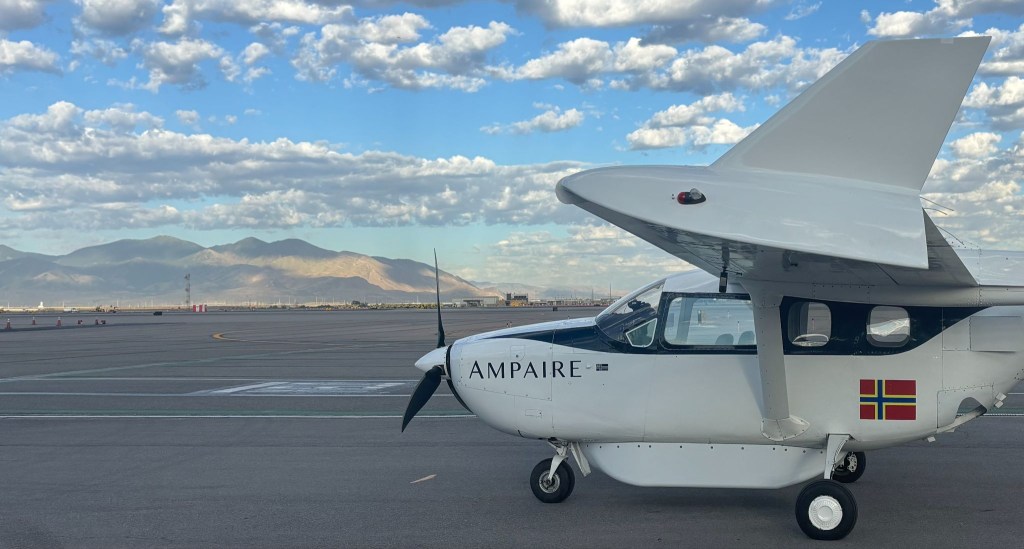
The aircraft involved was California-based Ampaire’s hybrid-electric EEL testbed, which flew from the company’s headquarters at Long Beach Airport (KLGB) to Salt Lake City International Airport (KSLC) on Monday, according to FlightAware.
Ampaire is using the EEL—a modified Cessna 337 Skymaster—to develop and refine its flagship AMP-H570 hybrid-electric propulsion system. The AMP-H570 is intended to power the company’s Eco Caravan, a retrofitted Cessna 208B designed to reduce fuel burn by 50 to 70 percent without sacrificing the Caravan’s regional range.
The FAA said Thursday that the hybrid-electric EEL flight marked the “second major step” in its eVTOL (electric vertical takeoff and landing) Integration Pilot Program (eIPP). The agency launched the eIPP at the White House’s direction in order to collect data from real-world operations of precertified electric, hybrid, and autonomous aircraft, the idea being that it could inform future regulatory standards.
By the end of the program, which is expected to span three years and 26 states, Ampaire hopes to begin demonstrating the Eco Caravan in Utah. It is the only hybrid-electric engine manufacturer participating in the eIPP, though other partners are developing hybrid-electric aircraft.
Thursday’s demonstration marked the start of uFLY, the UDOT-led portion of the eIPP being conducted in partnership with Oregon, Idaho, Arizona, and Oklahoma. It is one of eight lead projects the FAA announced earlier this year.
Per UDOT, activities will take place in a variety of locations including “urban areas, rural corridors, mountainous terrain, and wildfire-prone regions” across the Western U.S. In addition to the EEL and Eco Caravan, it intends to oversee demonstrations of all-electric aircraft built by Joby Aviation and Beta Technologies. The department said the effort comprises more than 30 public and private partners.
Beta in July conducted the first official eIPP operations, delivering organs manufactured by its customer United Therapeutics in Maryland and Virginia.
Utah Looks to the Future
Ampaire in July conducted non-eIPP flights between California and Utah. According to co-founder and CEO Kevin Noertker, this week’s demonstration was different.
“uFLY is about moving hybrid-electric aviation from demonstration into real-world operations,” Noertker said in the company’s announcement Thursday.
The manufacturer said eIPP activities will begin with the EEL for “early operational learning” purposes. Electric propulsion drives the modified Skymaster’s nose propeller, while combustion propulsion drives the aft propeller. Its battery systems are produced by a Utah-based company. Because the Ampaire powertrain can recharge during flight, it does not require new charging infrastructure at airports.
The EEL landed at Salt Lake City International on Monday evening. On Thursday morning, Ampaire test pilots flew it to Cedar City Regional Airport (KCDC). It departed Cedar City later that day and landed back at Long Beach Airport at 12:48 p.m. PDT, per FlightAware.
Ampaire said the Long Beach to Salt Lake City leg of the mission covered about 648 miles in 4 hours and 18 minutes on a single charge. The Salt Lake City to Cedar City leg lasted one hour and 45 minutes and covered about 240 miles. The company estimated the EEL flew 1,340 miles across 10 hours during the three-leg campaign.
“Over Utah’s mountainous terrain and high-density-altitude conditions, the additional electric boost power helped us climb through conditions that would have been much more limiting in a conventional-engine-only configuration,” said Zack Kraus, one of the company’s test pilots.
Ampaire said the Salt Lake City-Cedar City route “reflects the types of missions flown by cargo feeder operators, passenger carriers, and community air-service providers.” Per the FAA, it took the EEL along Utah’s Interstate 15 corridor and was a test of “future cargo service.”
Last year, UPS Flight Forward flew a simulated cargo feeder route in Salt Lake City using Beta Technologies’ all-electric Alia CX300, including loading and unloading the aircraft. Beta, which is also a uFLY participant, said earlier this year that its eIPP activities will include UPS, Alpine Air Express, and Bristow Group.
“Utah is creating a model for how advanced air mobility can strengthen urban-rural connectivity, support economic opportunity, and improve mobility for Utahns across our state,” said Matt Maas, UDOT’s aeronautics director, in a statement.
According to UDOT, uFLY will study how advanced aircraft could support cargo delivery, emergency response, wildfire response, and future passenger transportation.
In March, Utah state senator Stuart Adams said in a news release that the program will “position Utah to showcase the future of flight as we welcome the world for the 2034 Winter Olympics.” The same release notes that emerging aviation technology “could assist with logistics, emergency response, and regional mobility” at the Olympics.
The agency’s aeronautics division is using mobile command centers that are equipped with workstations and satellite connectivity in order to collect eIPP data from the FAA, coordinate the demonstrations, and monitor live video and flight data.
The FAA said Thursday that it will “use what it learns from these demonstrations to identify gaps, improve procedures, and support the safe integration of advanced air mobility into the National Airspace System.”
It added that UDOT and the other eIPP lead partners have more demonstrations in store for 2026. Texas’ Department of Transportation could be next in line to begin activities in September.