
Users of certain general aviation facilities in Texas will soon catch a glimpse of electric vertical takeoff and landing air taxi demonstrations, with commercial passenger service to one day follow.
Archer Aviation, which is pursuing FAA certification of its four-passenger Midnight eVTOL air taxi, on Friday shared maps for planned networks covering Dallas-Fort Worth, Houston, and Austin. The networks include FBO locations and other GA facilities across the three cities.
Eventually, Midnight will use vertiports—heliports designed to accommodate eVTOL aircraft—for its operations. But the aircraft is also designed to take off conventionally from a runway, and Archer plans to bring it to Texas for demonstration flights ahead of expanded VTOL testing and certification.
The company plans to install electric aircraft chargers across the Texas Triangle to support its planned participation under a federal pilot program designed to gather operational data on the novel aircraft.
“Our planned networks will make the benefits of electric air taxis real for Texans—trading hours in traffic for minutes in the air, while connecting the biggest airports, business districts, and sporting hubs in ways that America’s largest megaregion needs to grow,” said Archer founder and CEO Adam Goldstein in a news release.
The all-electric Midnight is intended to provide quiet, zero-emission, 10-20-minute flights, with a maximum range of 100 miles and speed up to 150 mph. It comprises 12 propellers, half of which support only vertical takeoff and landing. The other six are tilt propellers designed to enable the aircraft’s transition from vertical to wingborne flight.
Midnight will be piloted at launch, but Archer is working toward future uncrewed operations. It recently acquired autonomous eVTOL developer Wisk Aero from Boeing and is developing Zee, an AI foundation model designed to provide copilot assistance and handle ATC communications, among other capabilities.
Air Taxis at GA Facilities
Maps shared by Archer detail exactly where the company plans to demonstrate and later operate Midnight.
Dallas-Fort Worth
The Dallas-Fort Worth network would comprise:
- DFW Corporate Aviation at Dallas Fort Worth International Airport (KDFW)
- Signature Aviation and Atlantic Aviation terminals at Dallas Love Field (KDAL)
- Atlantic’s location at Addison Airport (KADS)
- Arlington Air Center at Arlington Municipal Airport (KGKY)
- Modern Aviation’s FBO at Fort Worth Meacham International Airport (KFTW)
- Alliance Aviation Services at Perot Field Fort Worth Alliance Airport (KAFW)
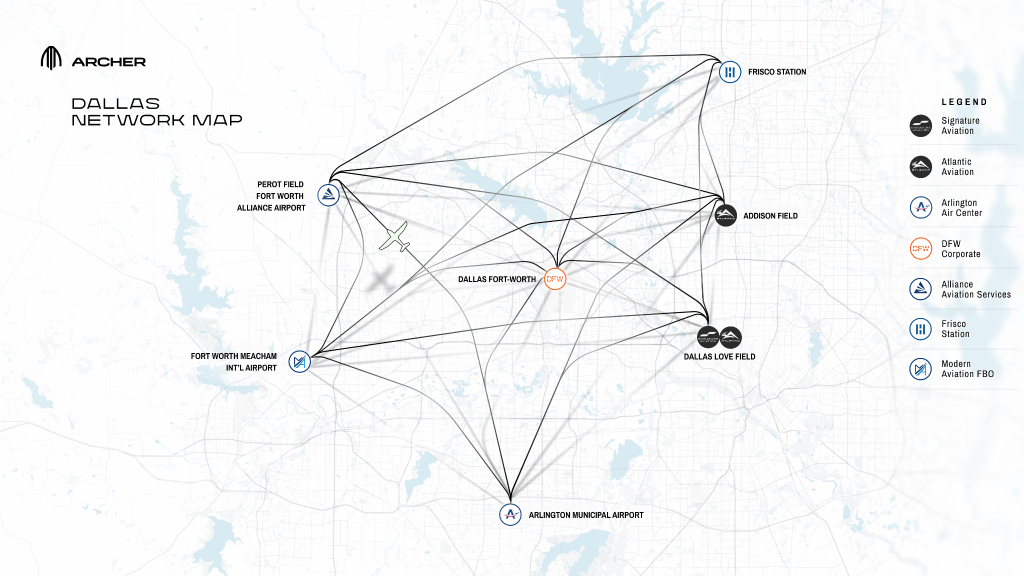
Travelers would be able to fly from those sites to locations such as the 242-acre Frisco Station business hub, which also surrounds residential communities, hotels, and the headquarters of the NFL’s Dallas Cowboys. The company is partnering with real estate developer Hillwood, which is part of the joint venture that owns Frisco Station.
Transport to sporting events is one of Archer’s key focuses. The company in 2024 said it was in discussions with the Los Angeles Rams on potentially exclusive vertiports near SoFi Stadium in Inglewood.
Houston
Archer also plans to fly Midnight out of Signature’s terminals at George Bush Intercontinental Airport (KIAH) and William P. Hobby Airport (KHOU), as well as GlobalSelect at Sugar Land Regional Airport (KSGR). Its subsidiary Wisk in 2024 announced partnerships with the city of Sugar Land and Houston Airports, the city’s department of aviation, to explore bringing operations to these three airports.
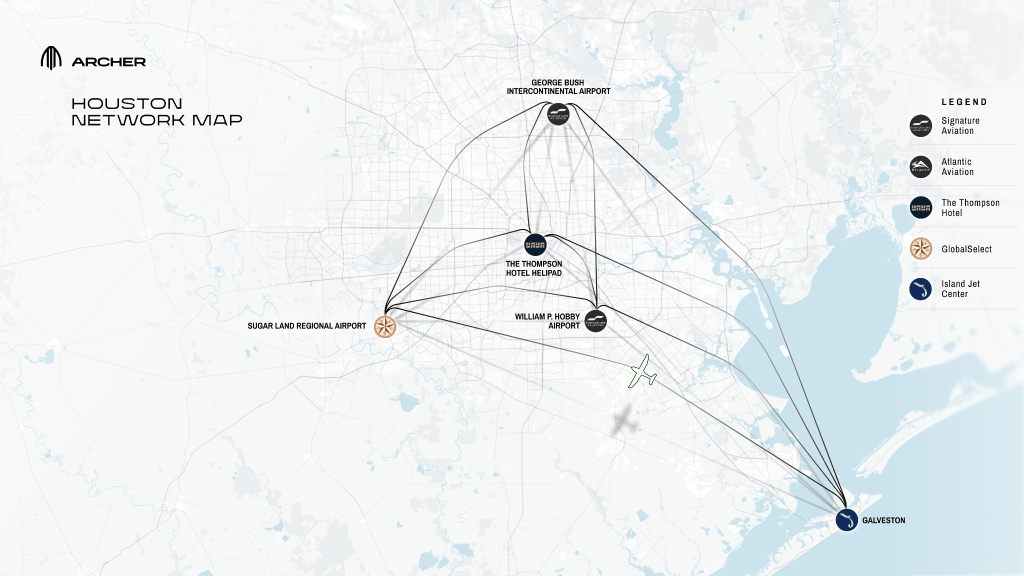
The Houston network would connect to downtown Houston’s Thompson Hotel Helipad. It would also link to the Island Jet Center in Galveston, offering access to beaches.
Archer’s customer and investor United Airlines uses George Bush International as its primary Texas hub. The carrier in 2021 placed a conditional order for up to 200 Midnight aircraft and in 2022 made a $10 million predelivery payment for 100 of those aircraft.
Austin
The smallest of the three networks, Archer’s map of Houston includes Signature’s Austin-Bergstrom International Airport (KAUS) location and the Henriksen Jet Center at Austin Executive Airport (KEDC).
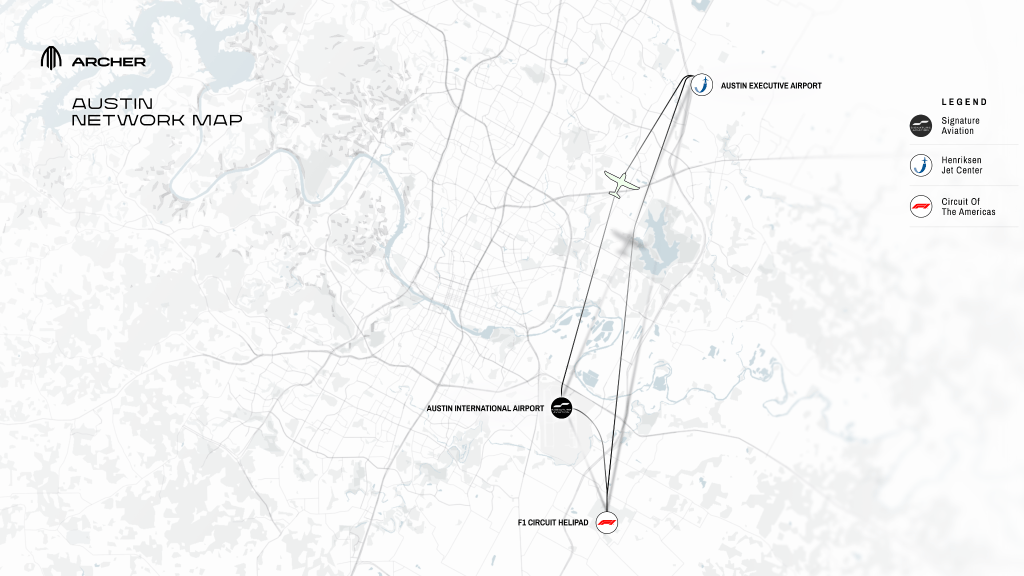
The network would offer transport between Austin-Bergstrom and Austin Executive Airport to the helipad at the Circuit of The Americas, providing access to Formula 1 auto racing events.
Midnight will be on display Friday and over the weekend at the Formula 1 United States Grand Prix, though it will not fly there.
Not Just Texas
Texas is the fifth market for which Archer has provided maps of its planned networks, joining the San Francisco Bay Area, New York City, South Florida, and Los Angeles. In LA, the company owns the lease to Hawthorne Municipal Airport (KHHR) and has announced plans to build a vertiport in the downtown area.
Vertiport infrastructure at GA locations in the other markets could soon follow. Outside Texas, the manufacturer is partnering with Signature, Atlantic, Modern Aviation, Clay Lacy Aviation, and Skyports, as well as regional partners that operate one or a handful of sites.
The networks will be powered by chargers purchased from competitor Beta Technologies. Through a joint effort, the companies plan to install 250 systems across Texas, New York, California, and Florida.
When Will Midnight Arrive?
Archer is preparing for operational activities under the FAA’s eVTOL Integration Pilot Program (eIPP) in the coming months. It is part of projects led by the Texas Department of Transportation, Florida Department of Transportation, and Port Authority of New York and New Jersey.
The company in recent weeks conducted demonstration flights at airports in northern California and plans to bring Midnight to LA next, followed by Texas and Florida. Planespotters in those states could be the first to witness the air taxi transition from vertical to wingborne flight, which Archer in March said it was “on track” for later this year.
Routine commercial passenger service will take a bit longer to materialize. Though Midnight is designed for both vertical and conventional runway takeoffs, Archer has yet to demonstrate a crewed transition, which will be key in its certification efforts.
However, the company is ramping up testing. Per FlightAware, its preproduction prototype flew 16 times between October 13 and 18, making at least one sortie per day. Its production-representive, VTOL-capable test aircraft flew twice on Tuesday according to FlightRadar24.
Archer stopped providing a firm certification timeline after repeatedly pushing back the milestone. But with plans to fly at the Los Angeles Olympic Games, it will likely seek to complete the certification process by 2028.