
It’s after 3 a.m. in Los Angeles, and the city is quiet. I’m sitting under a single lamp in my office surrounded by maps, handwritten kneeboard notes, charts with soda stains, and pages folded and refolded from repetition. Three weeks ago, I passed my private pilot check ride, yet it still doesn’t feel real. People assume the moment your DPE shakes your hand and says “You passed” is the finish line, but at 3 a.m. you learn it’s not a finish line at all.
It’s a doorway.
I started flight training at 57 years old and earned my certificate at 60, discovering that the sky doesn’t care how old you are—only how prepared you are. Preparation, I learned, requires curiosity, patience, physical stamina, quiet confidence, humility, and, above all, respect for the process and the machine.
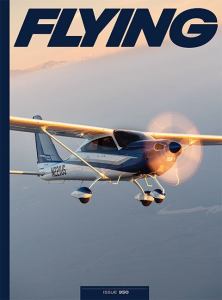
If you’re not already a subscriber, what are you waiting for? Subscribe today to get the issue as soon as it is released in either Print or Digital formats.
Most people who hear that I began flight training at 57 raise their eyebrows, and some chuckle the way pilots sometimes do when they hear about late bloomers. Yet a surprising number lean in closer, as if they are quietly searching for permission to pursue something they once set aside. Many adults carry a dream they shelved somewhere along the path of responsibility—and for me that dream was aviation.
My training began in a Cessna 182P out of Zamperini Field (KTOA) in Torrance, California, a busy general aviation environment. I didn’t chase speed of completion—I chased competence. If I was going to put my friends and family in an airplane, I wasn’t going to rush the process or treat it like a casual hobby. Flying is a craft, a discipline, and a responsibility. Rushing through training doesn’t teach you to fly. It only teaches you to get lucky.
- READ MORE: Pilots Must Embrace the ‘What-If’ Philosophy
- READ MORE: Mastering the Tailwheel Is the Ultimate Pilot Test
Southern California offers a master class in airspace management. The region is surrounded by the shelves and walls of Class B airspace around KLAX, intersected by Class C airports that require you to establish communication before entering, and dotted with Class D airports overlapping like puzzle pieces. Helicopter routes cross the basin, marine layers roll in from the Pacific, jet traffic descends through VFR corridors, and student pilots share frequencies with airline arrivals, news helicopters, and VIP TFRs.
Layered on top of all that complexity is the rhythm of SoCal radio communication, where timing, brevity, and clarity matter as much as the words themselves. Training here isn’t a novelty. It’s serious aerospace literacy, and learning to navigate this environment builds awareness and humility from the beginning.
My instructor, Gary Palmer, was calm, precise, and patient. Never rushed. Never rattled. The kind of CFI whose quiet tone tells you, “We’ve got time. Let’s do it right.” His saying was: “In this airspace, you don’t get to be casual. You get to be prepared.”
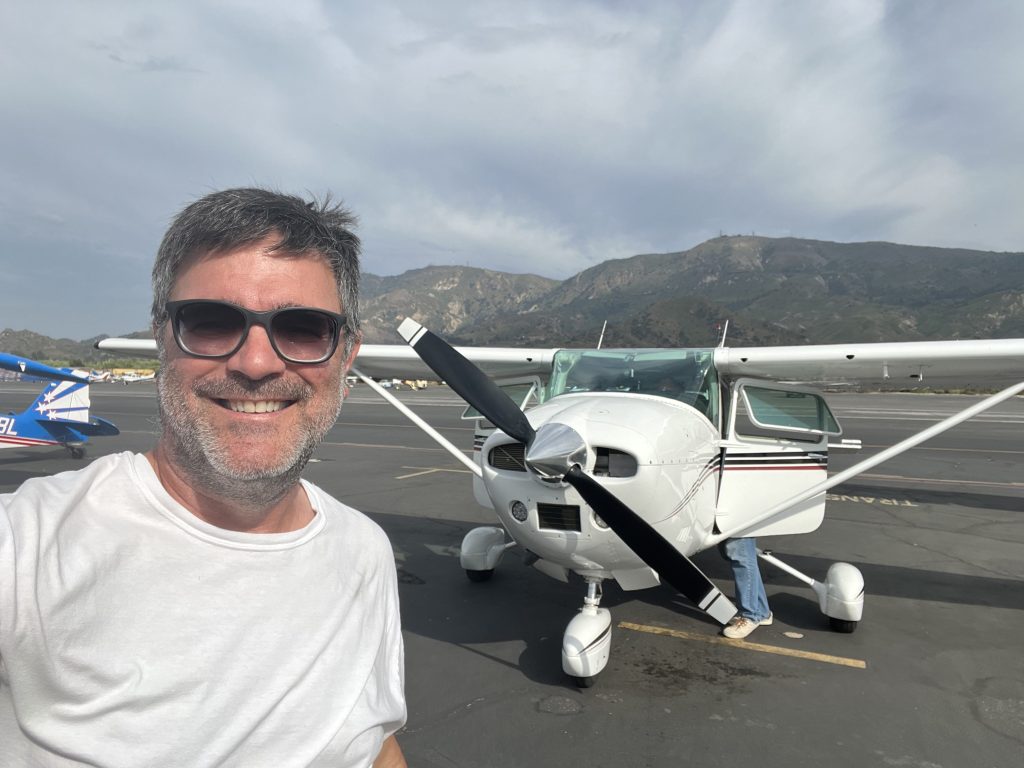
competence. [Credit: Hugh Milstein]
Palmer taught me that safety is not an attitude—it’s a habit.
People often imagine flying as a seated activity, but operating a piston aircraft from a hangar involves more physical effort than most expect. Pulling out a Cessna 182 from its hangar by hand, lifting heavy fuel hoses above shoulder height to refuel high wings, wrestling hangar doors that feel older than some of the runways themselves, and climbing in and out of the cockpit under the heat of the California sun all demand energy and stamina.
After one particularly exhausting lesson, while pushing the airplane back into the hangar, I realized how different real aviation felt from anything simulated on a screen. The experience motivated me to carve out daily time to exercise.
I began power walking every day with music and small hand weights, building the physical endurance that training required. A habit that absolutely carried me through training and the check ride. I was more prepared physically and mentally with my body tuned up.
Moment Everything Changes
There are only a handful of moments in life when you know in advance that you’re about to experience something permanent. Your first solo flight is one of those.
The morning air was clear and cool, my nerves sharp and focused, and my heart pounding with a mixture of anticipation and disbelief. When my CFI stepped out of the aircraft and closed the door behind him, the airplane suddenly felt lighter, and the sky seemed larger than ever before.
Throttle forward. Engine roar. Nose up. And then—lift. Freedom. Disbelief. I laughed. Out loud. Alone. At 80 knots. It felt like being given the keys to a Ferrari in high school and told “Take it on the freeway.”
On downwind, tower told me to extend. I flew toward the Queen Mary, calm, listening. My side window suddenly popped open midflight—strike one. I closed it and carried on.
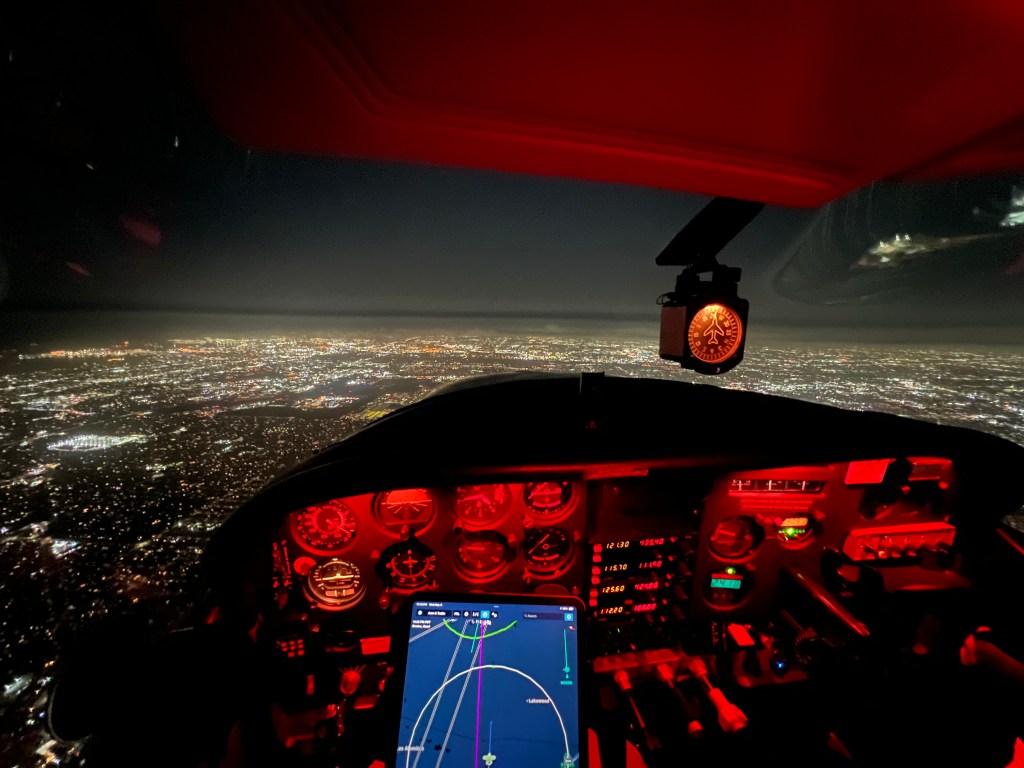
competence. [Credit: Hugh Milstein]
Landing? No. 4 in the pattern. You’ll call my base. Um, OK, sure. Like the runway rose to meet me. Like the earth gave me permission to arrive. I taxied off and exhaled everything I’d been holding for months. The feeling was less like victory and more like being welcomed into a community I had long admired.
My “aha” moment wasn’t on solo day. It was weeks later, flying to Camarillo (KCMA), California, for the first time via the special flight rules corridor over KLAX. Camarillo tower gave a traffic advisory: “Jet passing below you at 11 o’clock.” My instincts screamed—below me? Don’t they know I’m a student? But the training voice won.
Eyes outside. Hands steady. Breath calm. Then…click. The unfamiliar runway came into view. The coordinated relationship between throttle, pitch, and rudder pedals felt effortless. Suddenly, I wasn’t manipulating controls. I was shaping flight.
When we landed, Palmer simply looked over and said, “You flew that,” which, in aviation language, meant everything.
Behind every smooth landing there’s a series of challenges that rarely appear in photographs or social media posts. Fatigue from work. Predawn drives in LA traffic. Budgeting aviation costs responsibly. Weather delays causing weeks lost. Not progressing as fast as you wanted. Comparing yourself to “40-hour” pilots online. Days where you fly worse than last week. Days where life hits you before the airport does.
Flying exposes you. Not your age, but your habits. These fluctuations are part of the learning process, revealing your resilience.
Two moments shaped my crisis mindset. The first was a presidential TFR. Suddenly during a lesson, a known TFR changed its start time, and we were minutes from violating restricted space. Palmer’s voice was calm as water: “We divert now.”
And we did. Without drama.
The second was an instance of lost comms and having to squawk 7600. I learned that hand-held radios should be battery tested and frequency set before every flight. I also figured out the signal does not reach as far as I thought it would.
Emergencies aren’t events. They’re evaluations.
On my student solo cross-country to San Diego, I called SoCal Approach for flight following.
ATC replied: “You’re doing a great thing getting flight following. We’ll keep you safe.” Then an airline pilot on frequency chimed in: “Exciting times!” That moment made me realize aviation isn’t solitary. It’s a conversation happening in the sky. It’s a community connected by radios and responsibility.
Check Ride
The week before my check ride I experienced stress like I hadn’t felt since college exams. To manage pressure, I booked a hotel next to the airport. Morning routine: Walk. Stretch. Breathe. Reset. The oral was long, detailed, and demanding, but I had all the materials I needed to “look it up” when needed. That helped.
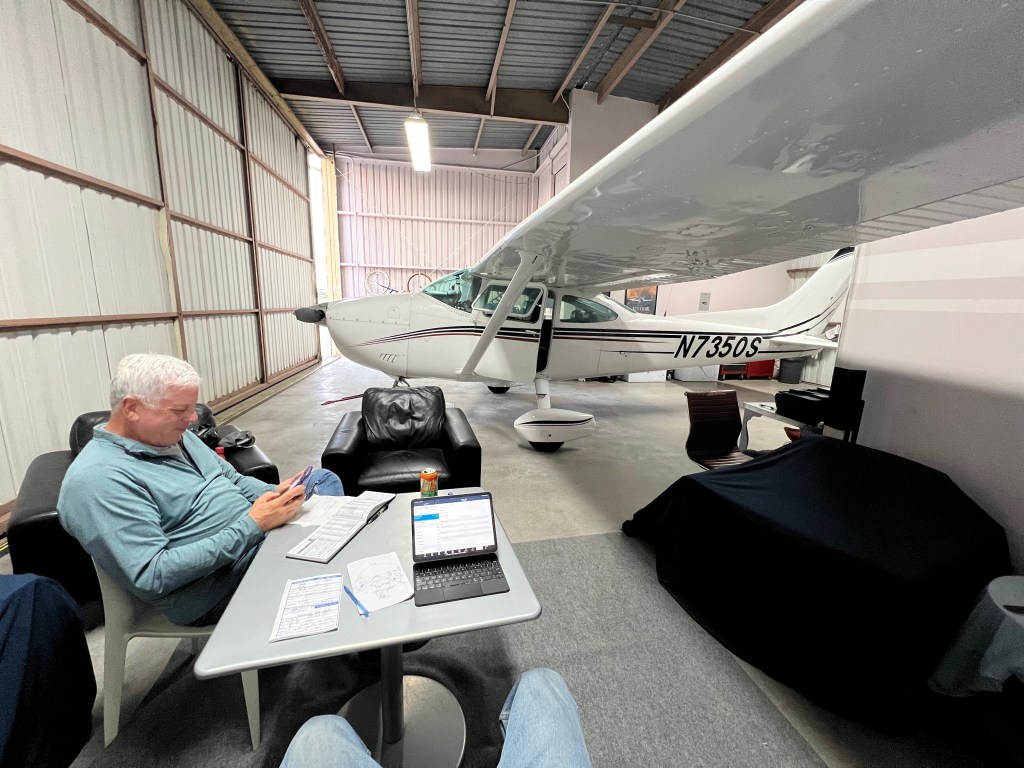
Then out to the airplane to find the marine layer had shut down my planned dead reckoning and pilotage route. I turned to the examiner and said, “I can’t go that way. It’s obscured. I’ll need a few minutes to replan.” He glanced at me from the right seat. “What might that look like?” That was the test—adapting with clarity, not panic. That moment didn’t test knowledge. It tested judgment.
Hours later, after flying through airspace I had never been through, and a short field landing back at my home airport, I taxied in and shut down. Silence. Then the handshake. “You passed.” I said nothing eloquent. Just three quiet “thank yous.” And my eyes…well, they weren’t dry.
Becoming a Beginner Again
Some days I felt 30 again. Some days I felt every bit of 60. But flying does something no gym, job, or meditation ever did: It sharpens life. You stay fit to fly. You sleep to fly. You hydrate to fly. You breathe to fly. Age tests your body.
Aviation strengthens your mind.
Flying taught me calm—the Jedi-level kind. The type where your breath does more than your muscles. I discovered my brain has a “focus mode” I didn’t know existed until I needed it approaching Santa Barbara (KSBA) runway numbers during a night cross-country.
I hope other late-life pilots learn that you’re not late. You’re not behind. You’re exactly on time for your own runway. When you start, you’ll discover that your brain still learns. Your body still adapts. Your courage still answers the call. If you’re thinking about flying, start. Not someday, but now.
And when you do, I’ll be the voice on frequency saying, “Exciting times.”
Personal Operating Doctrine
» IMSAFE before every flight: Illness, Medication, Stress, Alcohol, Fatigue, Eating/Emotion. If one is off, I’m off.
» PAVE in planning: Pilot, Aircraft, enVironment, External pressures. For the last one, money/time pressure is the stealth risk. Remove it up front.
» Three-strikes rule: Three small anomalies equals one big decision to end the flight.
» Flying twice weekly ideal: If life won’t allow it, protect at least one session and add a chair-flying slot midweek.
» Kneeboard ticket every flight: Tach start/stop, oil, fuel by tank, total usable, projected endurance (set a clock countdown timer every flight), density altitude, winds, radios used, lessons learned. These become breadcrumbs—and memory is a slippery instrument.
» Towered vs. nontowered builds complementary muscles: Radio precision at one, self-sequencing and spacing discipline at the other. Practice extended downwinds, short approaches, and go-arounds on purpose. Make “breaking off the approach” a victory, not a failure.
» Lost comms: Brief it before taxi. Know 7600, light-gun signals, and your local patterns. Keep a charged handheld in your bag. Use it to get ATIS before flight, assure it’s working, and you can check battery level. Test it for real during a lesson with your CFI.
Health and Mindset for the Late-Blooming Pilot
» Power walk with your favorite music for 30 minutes every day. It turns stress into stamina.
» Sleep as preflight. The night before counts more than you think. If life stacks stress, consider a later lesson.
» Strength is practical. You feel the hangar doors, the towbar, the ladder. Light strength work pays dividends.
» Don’t fly hungry.
» Ask for scenario lessons. “Today, we’re diverting from a family flight” teaches 10 times more than another perfect pattern.
» Reframe “slow.” You’re not slower—you’re more layered. The way you synthesize rules, weather, radio work, and judgment at 60 can be stronger than at 20.
» Celebrate pauses. Breaks are part of endurance sports. This is an endurance sport.
Recommended Gear
The right equipment doesn’t make you a pilot, but it can make learning easier and safer.
» iPad + ForeFlight: Unrivaled situation awareness; layer TFRs, traffic, and weather. 3D flight path tool, great for post flight debrief with your instructor.
» Physical logbook: Keep it basic. https://aviation.gleim.com/shop/logbook/
» Flight bag: I really like this one because it holds all my stuff, and you can custom embroider it. Go ahead, splurge. https://www.sportys.com/flight-gear-crosswind-bag.html
» Hand-held comm radio: The day you need it, you need it. https://www.sportys.com/pj2-plus-com-radio.html
» Apple Watch (or any health tracker): Guardrails for health and habit.
» Kneeboard and pen: Batteries die. Paper doesn’t. https://thehangar.com/large-trifold-kneeboard.html
» Headlamp: Safety and predawn preflights. https://www.sportys.com/flight-gear-universal-aviator-s-light.html
» Sporty’s E6B physical and electronic calculator: You can take it into the FAA written test.
https://www.sportys.com/asa-composite-e6b-computer.html
» FAR/AIM: You’ll want to bookmark these rules. Also they’re good to look stuff up on your practical test. https://www.sportys.com/far-aim-2026-asa.html
Study Guides and Communities
Training is easier when you surround yourself with the right information and people.
» Boldmethod: Sign up for the mini quizzes to your inbox.
» NAFI: Not just for flight instructors. Members get great discounts for ForeFlight and much more. https://nafimentor.org/
» Gleim FAA Knowledge Test Prep (book and online tests): I took an online written test every day for a month, and was ready for the FAA exam. https://aviation.gleim.com/shop/ppkt/
» King Schools PPL check ride video: Watch it at least 1,000 times and you’ll be ready. https://kingschools.com/online-private-pilot-practical-test-oral-exam-flight-test
» Schiff monthly Zoom: Listening and participating in seminars every month gave me real connection and confidence. Highly recommend you take advantage of Brian Schiff’s decades of wisdom.
This feature first appeared in the August Issue 973 of the FLYING print edition.