The teen years can be troubling, more for some than others. Unfortunately many are faced with external forces such as brushes with the law, housing instability, gang violence, or simply being told by authority figures (parents or teachers) that they won’t amount to anything. This can put you into a downward spiral that robs you of joy and makes you lean toward bad choices because you don’t see a future for yourself.
Then one day you find that thing that saves you. For Sean D. Tucker, award-winning aerobatic pilot and aviation celebrity, it was an airplane ride he took at the age of 17.
“You might say flying rescued me,” said Tucker, 73. “Because it gave me something else to do besides get into trouble and enabled me to be the best version of myself. I’m not saying it’s a very good version, but it’s the best I got.”
If you’re not already a subscriber, what are you waiting for? Subscribe today to get the issue as soon as it is released in either Print or Digital formats.
Tucker realized that he had found what brought him joy. He earned a commercial pilot certificate and instructor rating and began a crop dusting business. Then after taking an aerobatics course to get over his fear of crashing, he pursued a career as an aerobatics pilot.
The airshow circuit is where most people are familiar with Tucker. He has flown in more than 1,000 shows around the world and uses his aviation celebrity status to help others. In 2013 he was named chairman for the EAA’s Young Eagles, a program that enables kids ages 8-17 to ride in small airplanes for free. For many children, that short flight ignites an interest that grows into a passion for the rest of their lives—and it changes them in a good way, just like it did for Tucker.
If flying lifted Tucker out of the darkness, he theorized it could help other kids. So in 2014 he and his son, Eric Tucker, established the Every Kid Can Fly program at Rancho Cielo, an alternative high school program in Salinas, California. Alternative high schools offer more individualized education where the students often work at their own pace and attend three hours of class a day rather than five.
- READ MORE: Donation to Expand Bob Hoover Academy Fleet
- READ MORE: Young Eagles Pass 2M Youth Flight Mark
The idea of the program, according to Sean D. Tucker, was to give disadvantaged youth the opportunity to learn to fly for free. Learning to fly can be life changing, and it was Tucker’s intention to give the children hope and direction and show them they could accomplish their goals if they put their minds to it, despite the trauma they live with.
“It was an after-school program,” he said. “In two or three years I learned that there had to be more rigor. There needed to be more accountability on the part of the students because an after-school program dealing with the probation department wasn’t it.”
In 2016 the Tuckers, with the help of an administrator at Monterey County Office of Education (MCOE) created a transportation-pathway, diploma-earning high school classroom in Salinas—the Bob Hoover Academy.
Hoover was a mentor and close friend of Tucker’s, and when the two were paired for appearances at airshows and fly-ins, it was much like watching a comedy routine.
Hoover, an accomplished test pilot in the Air Force who became one the most well-known aerobatic aviators, died in 2016. But it wasn’t Hoover’s aerobatic prowess that made Tucker want to name the academy after his friend.
“I told Bob I wanted to name the academy after him because of his resilience and his iron will,” said Tucker. “When he was beginning to fly, he got violently airsick. Without his glasses, he was blind as a bat. But he stuck with it. He became one of the most iconic, beloved aviators in America. He was a gentleman who valued education, tenacity, and dignity, and despite his aviation ability remained humble and reverent, making him a great role model.”
Inside the Academy
The Bob Hoover Academy (BHA) is a public-private partnership that offers a full high school curriculum geared toward STEM and aviation.
The students use the Aircraft Owners and Pilots Association’s ground school curriculum. In addition to flying airplanes, they have access to go-karts, rock climbing, and aviation field trips.
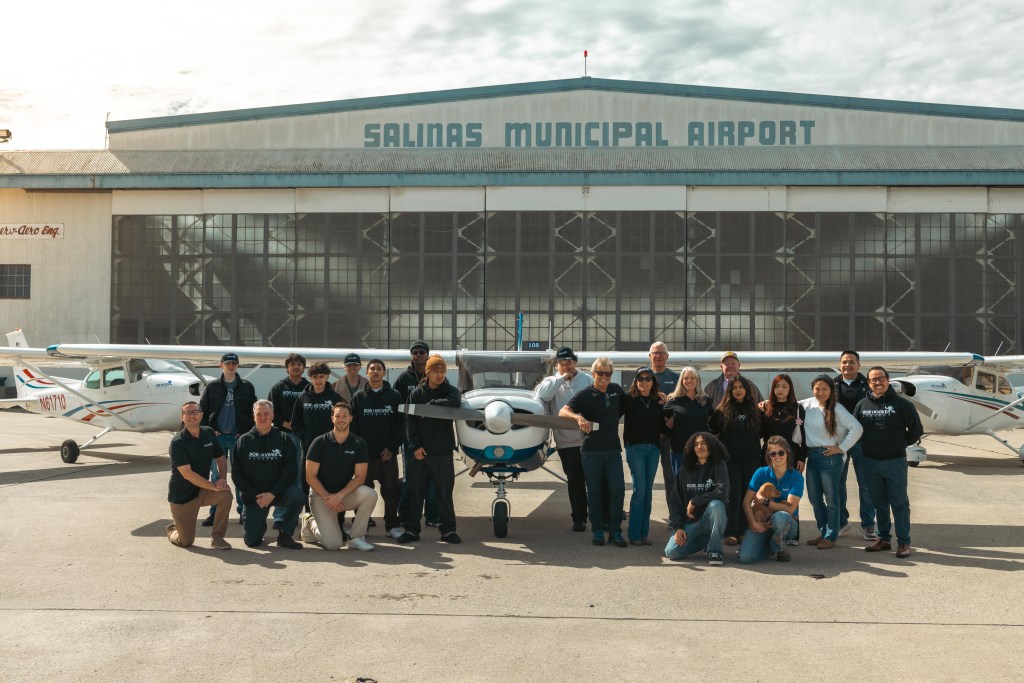
The BHA is based at Salinas Municipal Airport (KSNS). Students attend a weekly ground school and do flight training in two Cessna 172s, a C-152, a 1947 Piper Cub, a newly donated vintage side-by-side taildragger, and a Redbird FMX AATD. Tucker said all the aircraft were donated. If an aircraft is donated but doesn’t fit the mission—for example, it has a glass panel instead of legacy round dials—it is sold and the proceeds used to buy a more mission-friendly machine.
It’s up to the kids if they get to fly or not, Tucker said.
“We do ground school twice a week in the afternoon,” he said. “If they don’t go to ground school that week for school, they don’t fly, because they have to put skin in the game. We’re not charging them anything, but they’ve got to put academic skin in the game. They’re welcome to come to high school, but I’m not going to spend money on them learning to fly until they invest time in themselves.”
Tucker flies for free with the students and said he employs two CFIs who are “paid $85 an hour to be accountable and be the best they can be” because the program is about nurturing and enabling the development of the students and not instructors building hours.
As of early April there are 17 students enrolled in the academy. According to Tucker, many of the youths are referred through the juvenile justice system.
“We get them from the [local] district attorney, prosecuting attorney, and the probation department,” he said. “They’re integrated with kids who also want to thrive.”
The students range from ninth to 12th grade and attend academic classes from 9:30 a.m. to 2:30 p.m. PDT. They’re pulled out of class for flight lessons.
Tucker stressed that accountability is key, and the students quickly learn to take responsibility for their actions.
![Sean D. Tucker and his son established the Bob Hoover Academy in 2016 to inspire teenagers to pursue aviation careers. [Credit Avian Creative]](https://www.flyingmag.com/wp-content/uploads/2026/08/046A0485-e1785763653101.jpg?w=825)
“Students are subjected to regular drug tests because they’re flying airplanes,” said Tucker. “[They] cannot have THC in their systems. We have a go-kart program. You’re not going to drive my go-karts if you have THC in your system. We have a driver education program. You’re not going to drive my cars with THC in your system. We go rock climbing. You’re not going to go rock climbing because you’re high. We can’t trust you to make the right decisions. If we lose a kid to an accident, we’re out of business.”
The students take part in regular sessions with a behavioral psychologist to help them manage external stressors. They also have the opportunity to be enrolled at a local community college, where they learn job skills that lead to careers.
When a student struggles, academy officials will work with them to get back on track. But ultimately it’s up to the student.
“They have to do the heavy lifting,” Tucker said. “It’s like in aviation. You know, in my whole career, in all the fatalities that I’ve seen—every single one of them, as a matter of fact—has been pilot error. You can kind of see the people who are well over the edge, and they’re the ones that die. If I identify somebody, that’s a risk, I can mentor them. I can be upfront with them, but it’s still their choice whether or not they want to live or die. We don’t turn our backs on the kids, but we let them know the choice is up to them.”
Bob Hoover Academy relies on donations and directs people to its website (bobhooveracademy.org) to make donations. It also has a Carbon Cub that is under construction and will be raffled off as a fundraiser.
“I’m having professionals build it because [of that raffle],” he said. “We’re going to use that money to help the program.”
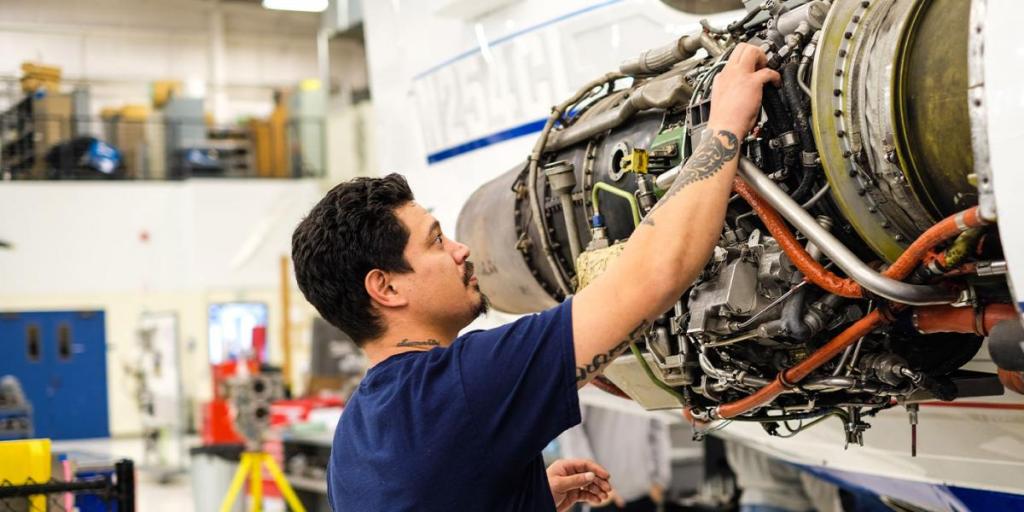
The academy has been around for 10 years, and there are success stories. Tucker noted that former students have gone on to careers as professional pilots flying jets, and others have become A&P mechanics. The latter is accomplished by enrolling in courses at the local community college while still in high school, allowing students to graduate with marketable job skills.
“We help them learn that their life is worth something,” Tucker said. “Some of them are getting into the aviation community. They become leaders. They become good employees. I’m very proud of these children.”
This feature first appeared in the June Ultimate Issue 971 of the FLYING print edition.
![Student at Bob Hoover Academy in Salinas, California [Credit: Avian Creative]](https://www.flyingmag.com/wp-content/uploads/2026/08/855A0250.jpg?w=683)