
By early 2027, general and business aviation pilots across the U.S. will be able to shift routine requests from voice radio to a digital format via flight plan service provider applications such as ForeFlight and Garmin.
The FAA has previously said Mobile Clearance—a digital tool it has been developing over the past decade to enable text-based IFR departure clearance requests—would deploy to airports nationwide next year. Agency officials speaking at the National Business Aviation Association Business Aviation Convention & Exhibition (NBAA-BACE) in Las Vegas last week reiterated the early 2027 timeline, Aviation Week reported.
The magazine quoted Paul Diffenderfer, the FAA Mobile Clearance technical lead, as calling the new digital tool a “beautiful thing” for GA pilots. Another agency program executive said the technology is “not a monolithic system unlike typical FAA systems.”
According to the agency’s website, nationwide deployment of Mobile Clearance could begin in February after the end of an ongoing evaluation period.
What Is Mobile Clearance?
The new tool is designed to modernize communications between pilots and air traffic controllers (ATCs) by enabling IFR departure clearance requests with a few taps on a phone or tablet. It will also include an IFR cancellation feature.
Traditional Pre-Departure Clearance (PDC) is limited to one clearance delivery per airport every 24 hours and restricted to registered callsigns. But Mobile Clearance will permit clearance revisions and be available on any aircraft. It will also be usable at non-PDC airports and include features not supported by PDC.
Per the FAA, pilots conduct more than half of 44,000 daily IFR departure requests verbally by contacting the tower, approach control, or center via radio. Switching to digital, text-based requests is intended to reduce readback errors and improve accuracy.
Mobile Clearance is also designed to mimic Controller Pilot Data Link Communication-Departure Clearance (CPDLC-DCL) functions used by commercial airlines and familiar to ATCs.
“Mobile Clearance is a smart, simple improvement that builds on technology pilots already use every day,” said FAA Administrator Bryan Bedford in July.
How It Works
Pilots will be able to access Mobile Clearance from their personal devices through ForeFlight and Garmin applications. It is only available via those two providers, though the FAA has received interest from others that it could onboard in the future.
Using the ground- and cloud-based system, pilots can request and receive IFR departure clearances via the applications they already use for flight planning, navigation, and weather tracking. They will be able to modify or cancel clearances and send responses such as “Accept” or “Wilco” directly to ATC, capabilities not offered by PDC.
Clearance requests can be filed 30 minutes before scheduled departure time. According to ForeFlight, the app will notify pilots when ATC responds and display a full route string and inset map preview. They will have six minutes to accept or reject the clearance before contacting ground.
For controllers, Mobile Clearance requires only an internet connection and commercial off-the-shelf products such as a 24-in. monitor, mini PC, keyboard, and mouse. Per Aviation Week, Diffenderfer said the interface “basically is a web page…and each tower or approach control [facility] has a unique interface with various settings for their facility.” ATCs would not need to phonetically spell out waypoints and T-routes, and they would have better visibility of which pilots are awaiting or have responded to clearances.
Where Mobile Clearance Will Be Available
Mobile Clearance is already available to business and GA pilots at certain airports in Texas, Kansas, and Wisconsin that are part of the FAA’s operational evaluation. Many more will come online next year.
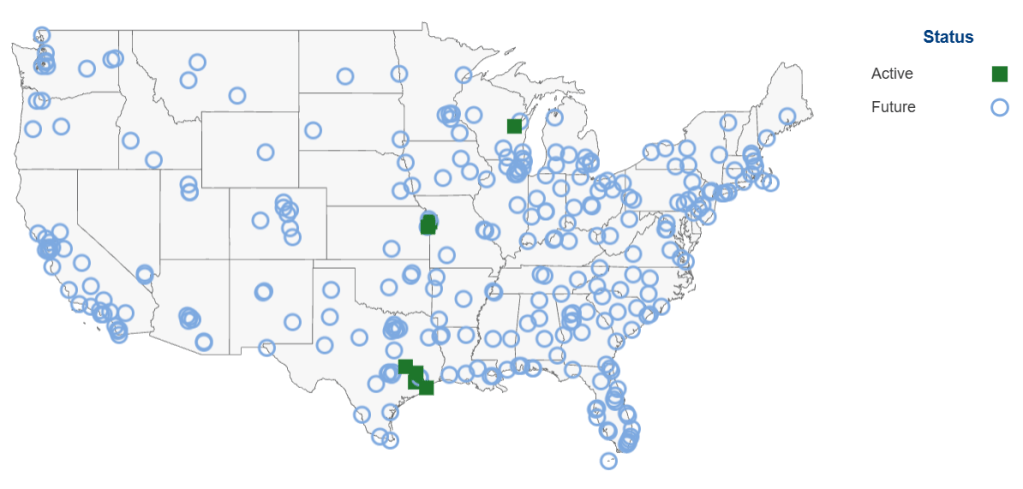
Following 2024 simulation testing, the FAA in May began evaluations at Sugar Land Regional (KSGR), Scholes International (KGLS), David Wayne Hooks Memorial (KDWH), and other Houston-area airports. It has since expanded them to the following facilities:
- College Station Regional (KCLL) in Texas
- Austin Executive (KEDC) in Texas
- Georgetown Executive (KGTU) in Texas
- San Marcos Regional (KHYI) in Texas
- New Century AirCenter (KIXD) in Kansas
- Kansas City Downtown (KMKC) in Kansas
- Appleton International (KATW) in Wisconsin
According to ForeFlight, Johnson County Executive (KOJC) airport in Kansas is next in line. Per the FAA, the evaluation will soon expand to Nashville. In addition, the IFR cancellation feature—which will help pilots transition to VFR—is expected to be available via Houston’s Terminal Radar Approach Control (I90) this Fall.
The FAA’s website provides a map of airports expected to receive Mobile Clearance in 2027. The agency plans to make the tool available at select nontowered airports and add an IFR release capability for those locations in the future, but the timing of the latter remains up in the air.