
In the coming months, the FAA will oversee trials of precertified electric aircraft in 26 states under its eVTOL (electric vertical takeoff and landing) Integration Pilot Program (eIPP). Hawaii is not one of them.
But the state’s residents and visitors will get a first glimpse of the technology during trial operations that began Thursday and are expected to continue for six to eight weeks.
The trials are being led by electric aircraft manufacturer Beta Technologies and Part 135 operator Surf Air Mobility, with additional support from Hawaiian Airlines. This marks the first time Beta is working with Hawaiian. Surf earlier this year placed an order for 25 of Beta’s Alia CX300 aircraft, with options for 75 more, and is the launch customer for CX300 scheduled passenger and on-demand cargo service, starting in Hawaii once the aircraft is certified.
The partners on Thursday began conducting demonstration flights with a prototype CX300 aircraft configured for cargo operations—the same aircraft, N401NZ, that Air New Zealand leased for demonstrations that concluded in February. The all-electric model takes off conventionally, unlike Beta’s eVTOL Alia A250, and can seat five passengers or about 1,200 pounds of medical equipment or other cargo.
The goal of the campaign is to collect data on the operational, economic, and infrastructure requirements for interisland Alia service—including as part of Hawaiian Airlines’ network, Beta said in a news release. The airline on Thursday hosted a launch event at Daniel K. Inouye International Airport (PHNL) in Honolulu.
The campaign will include flights between islands, a spokesperson for the partners told FLYING. Demonstrations will connect airports such as PHNL, Molokai (PHMK), Lanai (PHNY), Kahului (PHOG), Hilo International (PHTO), and Kona International (PHKO).
Beta will be the sole operator, with support from Surf’s Mokulele Airlines subsidiary, the spokesperson said. Hawaiian Airlines will share intelligence on operational performance and conduct feasibility assessments to determine what role it could play in the future.
“This program provides an opportunity to better understand how Beta’s electrified aircraft can support safe and reliable cargo and passenger air service for short-haul service while improving the environmental impact of that flying,“ said Diana Birkett Rakow, CEO of Hawaiian.
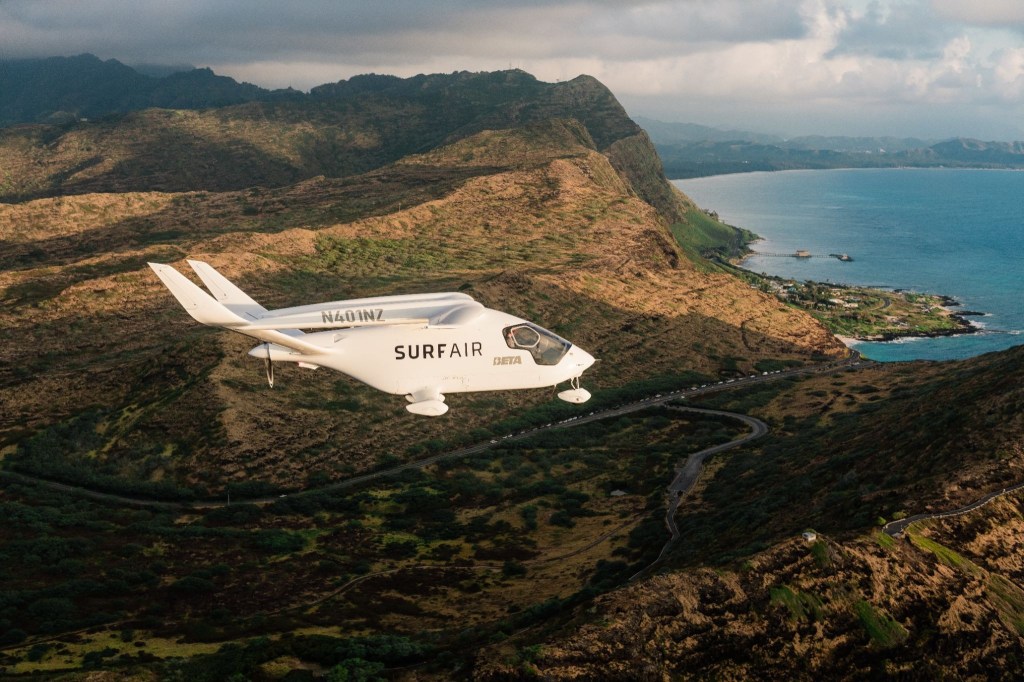
Beta said the partners will demonstrate the CX300’s performance across different weather conditions and operating environments. The company followed a similar strategy during its earlier demonstrations with Republic Airways pilots, flying the aircraft in New York in the winter and in Florida this past month.
Personnel will assess battery performance, energy consumption, and the costs of operating the aircraft. They will also study the requirements for maintenance, crew training, ground handling, safety, and charging infrastructure.
Beta’s planned network of aircraft-agnostic electric chargers spans more than 100 sites, with about 60 online as of June per Nate Ward, who leads the company’s North American charge network development. However, Thursday’s release notes the upcoming trials will use “existing Hawai’i airport ground infrastructure.”
The trials will also incorporate Surf’s SurfOS platform. Powered by Palantir’s Foundry, SurfOS uses artificial intelligence to adjust pricing, schedule crews, source aircraft, and recover aircraft on ground (AOG) for broker, operator, and enterprise customers. The broker offering is already in the hands of a few customers, with the operator platform set to launch later this year.
Hawaii and the Future of Flight
Though federal officials rejected the Hawaii Department of Transportation’s eIPP bid, which included Beta and Surf, the state is emerging as a key proving ground for electric aviation.
Per Beta’s Thursday news release announcing the new campaign, “Hawaii’s short route structure and established demand for regional air transportation make it an ideal environment to evaluate electric aircraft operations at commercial scale.”
Beta envisions the first CX300 passengers taking off in Hawaii, with Surf as the launch operator. The all-electric model has an intended cruise speed of 153 knots and demonstrated range of 336 nm, powered by the company’s H500A electric motor and a five-bladed, fixed-pitch pusher propeller. Per Beta, it will produce 75 percent fewer emissions than the Cessna 208 at a fraction of the operating cost.
The company’s vertical takeoff A250 uses nearly identical structures and systems but adds four vertical lift engines and propellers on wing-mounted booms. Beta is targeting Part 23 certification for the CX300 and the less conventional powered-lift pathway for the A250. As of Thursday, Alia prototypes and production-intent models have flown more than 135,000 nm.
Surf’s purchase agreement for up to 100 CX300 aircraft includes priority delivery positions, meaning it will take delivery of the aircraft shortly after it is certified for commercial service. It will begin with cargo operations under Mokulele Airlines but aims to be the first Part 135 operator to introduce electric aircraft for passenger service. In the future, it plans to add the A250 to its fleet.
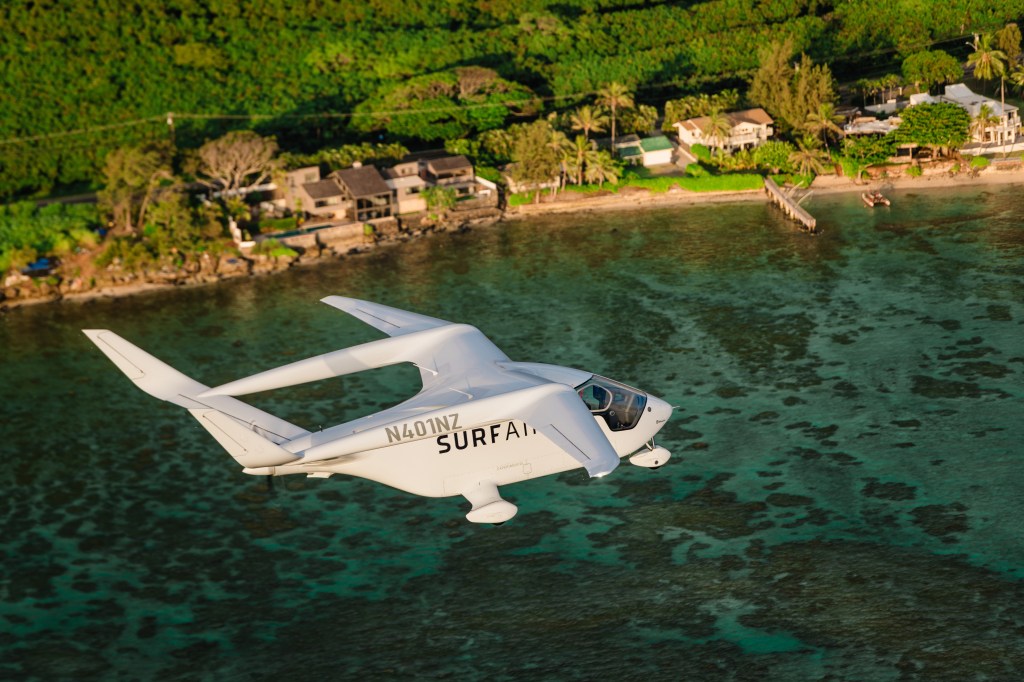
Surf is building a maintenance, repair, and overhaul (MRO) facility in Hawaii that Beta said will be the state’s exclusive, factory-authorized service center for Alia aircraft. The partners have designs to expand the MRO agreement to other markets and grant other operators access to the network.
Surf additionally made Beta its “preferred supplier” of electric ground infrastructure for its fleet, which comprises the Cirrus Vision Jet, Embraer Phenom 300, HA-420 Hondajet, Piper Meridian, and multiple airframes from Beechcraft, Bombardier, Cessna, Dassault, Gulfstream, and Pilatus.
Beyond Alia, Surf intends to operate Electra’s EL9 Ultra Short, designed for operations out of soccer field-sized spaces. It also has an exclusive arrangement with Textron Aviation to electrify 150 Cessna 208s that it ordered in 2021, using proprietary electric and hybrid powertrains. Per Beta, the partners will install chargers in “mutually agreed locations” across Hawaii.
Depending on how the CX300 trials go, Hawaiian Airlines could tap into that network in the future.
With interest from Surf and Hawaiian, the CX300 could become a fixture of future interisland transport. Notably, though, Beta’s release does not mention any demonstrations with the more cutting-edge A250.
Beta hopes to demonstrate the vertical takeoff variant during the eIPP. It is part of seven of the eight winning applications, with plans for cargo and medical logistics operations in New York, Vermont, Texas, Utah, Louisiana, and Florida. The company aims to fly the A250 with passengers by the end of the three-year campaign.
