
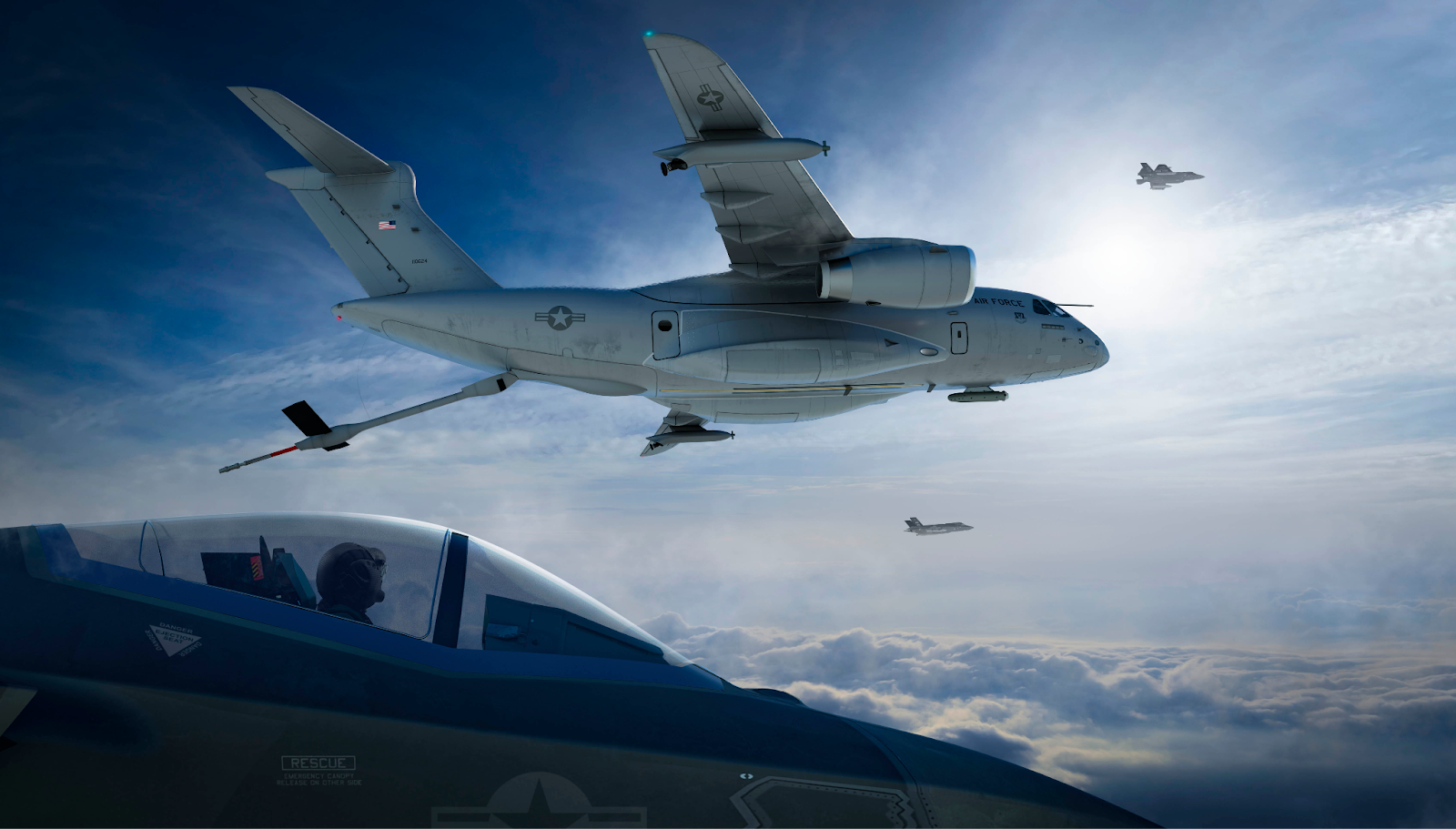
Embraer and Northrop Grumman are angling to be the go-to aerial refueling providers for the U.S. Air Force and its allies.
The companies on Thursday said they made a joint investment to “evolve” Embraer’s twin-engine KC-390 Millennium into a multi-mission tanker, augmenting its probe-and-drogue refueling system with an autonomous flying boom. Most military aircraft are compatible with only one of the two methods, which require different hardware integrations.
“We’re listening to our customers, particularly in allied nations, who seek greater operational autonomy and efficiency, and we’re exploring new technologies that will increase the versatility of the proven KC-390 platform and deliver that greater operational independence,” Tom Jones, corporate vice president and president of Northrop Grumman Aeronautics Systems, said Thursday.
Jones also told media at the company’s facilities in Florida that the partners hope to demonstrate the autonomous boom system in the “low single digit years.”
U.S. Navy and Marine Corps aircraft largely use the probe-and-drogue technique for which the KC-390 was designed. The receiving aircraft’s pilot maneuvers a rigid probe attached to the nose or fuselage into a shuttlecock-like drogue, attached to a flexible hose that trails the tanker. Once connected, the probe’s valve opens, and fuel can be transferred.
The Air Force, by contrast, fuels its fighters using the KC-135 Stratotanker, KC-46 Pegasus, KC-10 Extender, and other tankers equipped with a boom system. These aircraft have a dedicated boom operator who extends and inserts a rigid, hollow tube into a receptacle on the receiving aircraft.
The flying boom system has a significantly higher flow rate than probe-and-drogue and limits the external refueling hardware to one aircraft. But unlike probe-and-drogue, booms can refuel only one aircraft at a time.
The F-16 Fighting Falcon, F-15 Eagle, and F-35 Lighting II all fuel up using boom systems. Adding one to the KC-390 could allow Embraer and Northrop to accommodate thousands of new aircraft. The partners shared a concept of the next-generation tanker that appears to show it flying alongside a pair of F-35s.

The companies shared few other details on the project. Beyond the autonomous refueling system—which could eliminate the need for a boom operator—key features include “enhanced communications, situational awareness and survivability options, as well as adaptable mission systems.”
The KC-390 is flown by a handful of militaries and is expected to be delivered to a few others over the next several years. It carries up to 35 metric tons of fuel, with a maximum range of close to 4,600 nm. Takeoff and landing require only about 1,000 feet of runway.
“The KC-390 is an operationally proven and cost-effective platform that could quickly be added to the U.S. Air Force inventory,” said Bosco da Costa Junior, president and CEO of Embraer Defense & Security.
Embraer and Northrop’s Grand Plan
Northrop Grumman in 2008 earned the Air Force’s KC-X contract to replace aging KC-135s in partnership with Airbus. But Boeing protested the award, and its KC-46 ultimately won the bid. The Air Force last year opted to buy more KC-46s rather than conduct a competition that would have pitted the Pegasus against candidates for a Next Generation Air-Refueling System (NGAS).
Embraer and Northrop Grumman used the same “next generation air-refueling system” language in their announcement Thursday, suggesting they view the multi-mission KC-390 as a prime NGAS candidate. The partners said the concept supports the Air Force’s agile combat employment (ACE) strategy, which quickly disperses personnel and assets across a wide range of smaller bases rather than operating out of traditional, large overseas hubs.
Aviation Week reported that Northrop will pitch the KC-390 to the Air Force as part of a three-pronged approach to meet the needs of NGAS. The other prongs would be a smaller, uncrewed tanker and the large blended-wing body (BWB) demonstrator it is developing with JetZero. The BWB design is expected to begin test flights in 2027.
General John Lamontagne, commander of Air Mobility Command, told reporters in September that the Air Force is “looking at conventional tankers we know of today—something like a [KC-135 Stratotanker] or a [KC-46 Pegasus] as is—or something with a bunch of mission systems added to it, with defense systems, connectivity, intelligence and more.”
Partnering with Northrop, Embraer will look to get back into the tanker game after a boom integration for the C-390, in partnership with L3Harris, fell apart in October 2024.
The manufacturer also assembles the A-29 Super Tucano light attack and advanced trainer in Jacksonville, Florida. In 2024, three of them joined the Air Force Test Pilot School at Edwards Air Force Base (KEDW) in California. Embraer unsuccessfully pitched the A-29 for the Air Force’s Armed Overwatch program, losing out to Air Tractor and L3Harris’ OA-1K Skyraider II.