A French company this week joined American vertical takeoff and landing (VTOL) air taxi developers such as Joby Aviation, Archer Aviation, and Beta Technologies in unveiling a full-scale aircraft prototype.
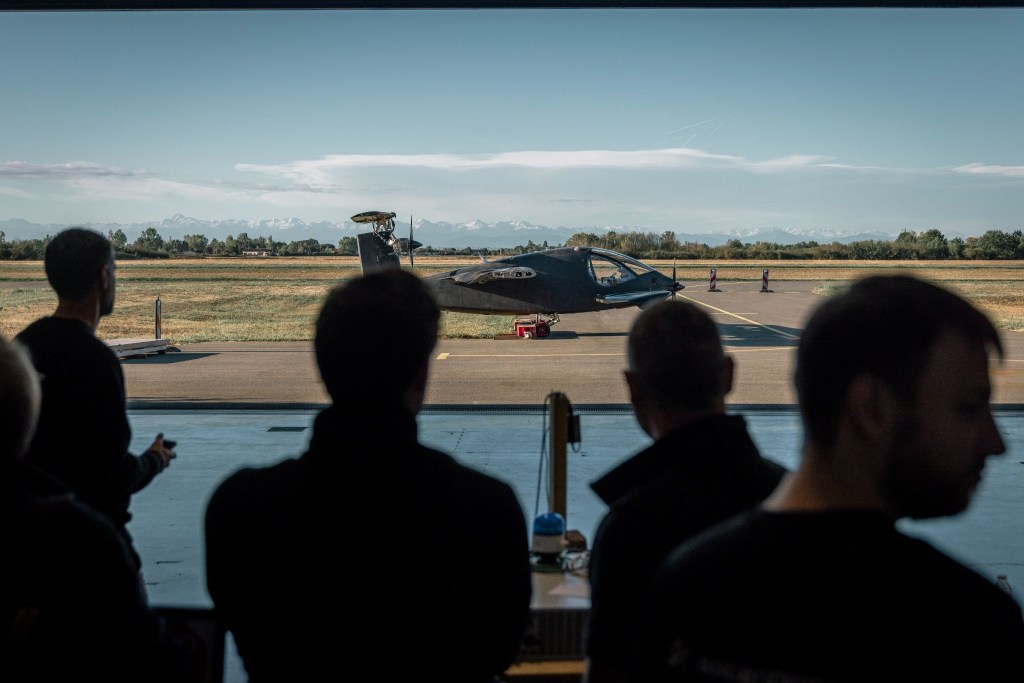
France’s Ascendance on Thursday unveiled the first full-scale article of its flagship Atea, designed for hybrid-electric passenger transport, cargo and medical logistics, and defense missions such as surveillance. The company in a news release said it will continue ground testing and system validation as it works to obtain a European Union Aviation Safety Agency (EASA) permit to fly for Atea’s first piloted flight.
Per its website, EASA certification is targeted for 2029.
The Atea demonstrator is also intended to validate Ascendance’s Sterna hybrid-electric propulsion system. The firm is developing Sterna to power a range of civil and defense platforms, from drones and EASA CS-23 light aircraft to CS-25 regional and commercial airplanes.
Ascendance has partnerships with Airbus to develop Sterna and with ATR to explore the integration of hybrid-electric propulsion on future regional aircraft. It is also working with Daher toward testing Sterna on the manufacturer’s aircraft, with an eye toward integrating the system in the future.
“The unveiling of Atea marks a decisive step in demonstrating our technological expertise,” said co-founder and CEO Jean-Christophe Lambert in a press kit. “It now opens the way to a new ambition: industrializing and deploying Sterna for civil aviation and defense, with the goal of building a leading European player in hybrid-electric propulsion.”
Ascendance Finally Hits Key Milestone
Ascendance’s unveiling of the first full-scale Atea aircraft was a long time coming.
The company spent eight years developing the prototype. It was founded in 2018 by four engineers from Airbus’ E-Fan electric aircraft program.
In early 2021, Ascendance shared a concept of Atea that featured a pair of ducted fans for vertical lift and a single three-bladed nose propeller. Later that year, it unveiled a revised design comprising eight ducted fans—four each on the main wing and a canard near the nose—and two propellers, one on the nose and another atop its tail section.
The company at the time said EASA certification would be complete by 2025. Lambert said a full-scale prototype would enter testing in 2023. Nearly three years later, Ascendance said it planned a first test flight in 2025.

The demonstrator unveiled Thursday features eight rotors integrated into its wings for vertical takeoff and landing, alongside two propellers for forward flight. It began assembling the aircraft in 2025, after it selected Safran’s EASA-certified ENGINeUS electric motors to power it.
According to the company’s press kit, it has already flown several subscale prototypes and completed wind tunnel and iron bird testing of the aircraft’s fan-in-wing system. It has also conducted more than 1,000 hours of full-scale hybrid-electric test bench testing for Sterna.
What to Know About Atea and Sterna
Atea was designed from the outset to integrate the Sterna propulsion system.
The VTOL aircraft is intended for a pilot plus up to five passengers, or it can be configured for cargo, medical, and defense missions. It has a targeted cruise speed of up to 250 kilometers per hour (about 155 mph). Range with four passengers will be up to 400 kilometers (close to 250 miles), extending to 900 kilometers (almost 560 miles) with two passengers. Atea is designed to recharge its batteries during flight, with turnaround time between trips as low as 15 minutes.
Sterna is designed to reduce fuel consumption, emissions, noise, and operating costs. According to Ascendance, it will give Atea 80 percent lower fuel burn and CO2 emissions, 75 percent less noise, and 50 percent lower operating costs compared to helicopters.
When installed on civil aircraft, Sterna would cut fuel burn and emissions in half and costs by 30 percent, per the press kit. For defense platforms, it would offer four times the endurance of an electric drone and, in all-electric mode, provide a lower acoustic and thermal signature than combustion-engine drones.
The company said Sterna is built to adapt power to each phase of flight and adjust the use of battery storage, onboard power generation, and power distribution based on the mission.
Per the news release, Ascendance is preparing to expand production capacity for Sterna at its Muret-Lherm Aerodrome facility in 2027.
“Work underway with Airbus, ATR and Daher…illustrates the integration potential of Ascendance’s technologies in both civil aviation and defense,” according to its media kit.