
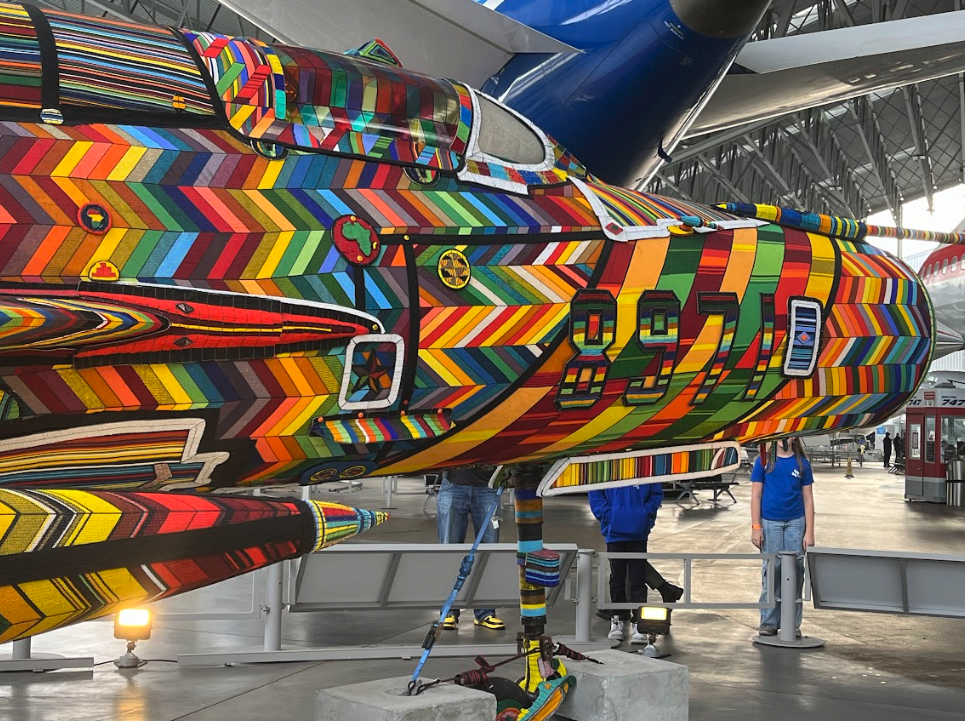
You have to make time for the things you want, and when they finally line up, it can be worth it, as was the case in finally getting to see The MiG-21 Project at the Museum of Flight in Seattle shortly before it closed. The exhibit features a decommissioned Cold War-era, Soviet-built aircraft with millions of tiny glass beads.
The MiG is believed to be the most-produced Soviet aircraft, with more than 13,000 rolling out of the factory. The MiG-21, sometimes known as “Fishbed,” has been used all over the world. With the collapse of the Soviet Union, they could be purchased, decommissioned, defanged, and imported to various countries.
The project was designed by South African artist Ralph Ziman. South Africa is known for its ornate beadwork art, and it took a team of craftspeople five years to transform the aircraft into a colorful work of art.

About the Exhibit
The beadwork is a combination of cloth and wire forms over complex angles that need more structure, such as wingtips. An eight-minute informational video on continuous loop tells the story of how the project came to be and features interviews with the artisans who helped create it.
You never think of beads being heavy until you see the video showing the crew carrying what look like beaded blankets and spreading them out before adding them to the aircraft. The final assembly was done in Los Angeles.
They used adhesive guns and wedges to apply the glue to the aircraft so that the beads will adhere to the metal skin.

It was important to find an adhesive that could withstand the metal expanding and contracting in reaction to changes in temperatures, as the MiG-21 was on display in the MOF’s outdoor pavilion.
The MiG Project is the final piece in Ziman’s 12-year Weapons of Mass Production Trilogy.
The exhibit begins in the museum’s Redbarn with examples of the strips of beaded cloth on display.
Touching the cloth is encouraged, and there is a placard that states this. I had to read that twice to be sure. It is strangely inviting to run your fingers across the cloth, feeling each bead, and knowing that millions were used and strung using needle and thread.

Bead-covered AK-47s are also part of the exhibit. They were designed as weapons of war, but they give off a decidedly different vibe when wrapped in colorful patterns. The same can be said for the flight helmets and portraits of the fighter pilots who are adorned in bead-covered gear. There’s even an image of the cockpit, which also features psychedelic displays.
There is an interactive component in the video room that allows you to digitally create a color scheme for an aircraft and then add the design to a looped video.
Walking around the beaded jet takes your breath away. You stare at it, your brain working hard trying to process what you are seeing—that it is not an elaborate paint job, but thousands of hours of painstaking work, two beads at a time.