In July, the FAA released new guidance on extended reality training technology, creating the first framework for its eventual integration into pilot training.
Stephanie Fussell, a scientist at Aptima who contributed to that guidance through her work with the FAA, International Civil Aviation Organization (ICAO), and industry working groups, spoke with FLYING about how the technology is already being used and the roles it will likely take on as it becomes more widely available.
Fussell first became aware of the technology now classified as XR while pursuing graduate degrees in aviation. She came across a paper exploring how augmented reality could be used for pilot training, and began researching the subject in depth.
“I realized that these technologies could really positively impact flight training, especially to make it more efficient, to make it safer, and to expand access, since simulators, especially qualified simulators, aren’t always available at all flight schools,” she said.
As Fussell continued her research into the benefits and limitations of XR, she was invited to join ICAO’s Personal Training and Licensing Panel and the FAA’s Air Carrier Training Aviation Rulemaking Committee, where she helped shape the standards governing how the technology can be added to simulators.
XR comes with numerous benefits, she said—it can increase engagement and motivation, help learners retain information for longer, and allow for practice of embodied movements, an advantage over a desktop simulator.
“It increases the immersion and takes that level of interaction up a bit,” Fussell said. “You also have the ability to practice and learn about unsafe situations.”
The technology is also much more affordable than a Full Flight Simulator or Flight Training Device, which could make it a good fit for flight schools that do not have the money or space for those systems.
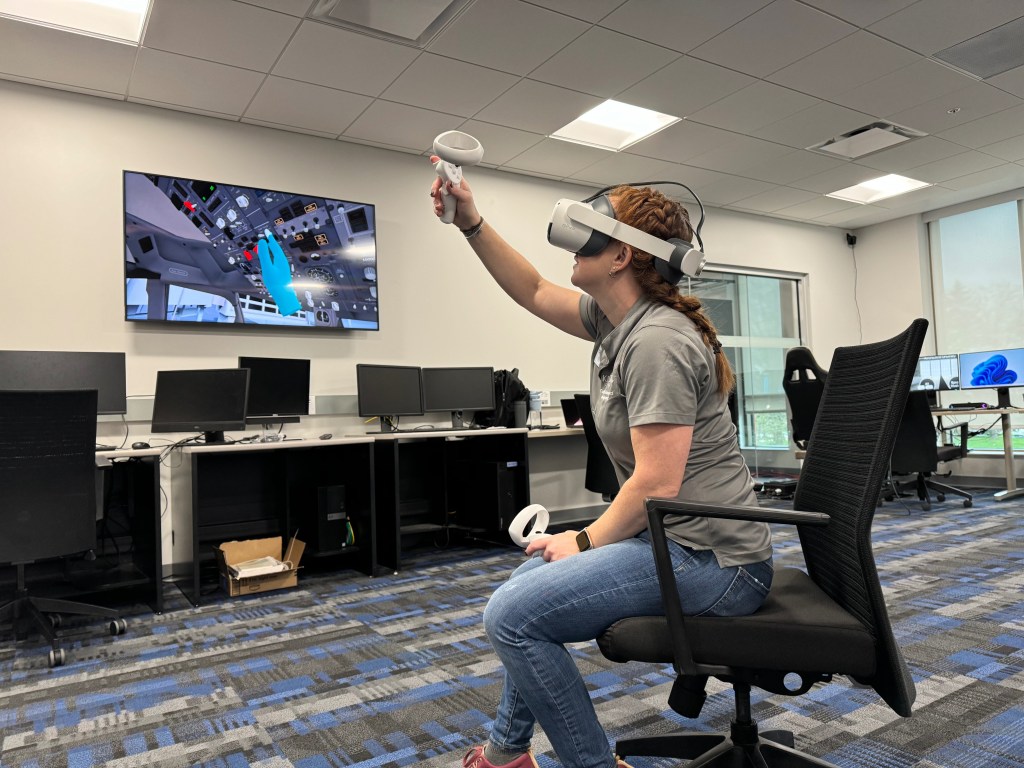
“This will help flight training environments have more simulators that are qualified without having to increase their physical footprint or change their space,” she said.
XR vs. VR
Extended reality is an umbrella term used to describe the integration of different levels of immersive simulation technology, both physical and virtual.
Virtual reality is usually contained within a headset, and doesn’t use physical elements outside that experience.
“Typically, in virtual, there’s no ‘real world’ perception, just virtual imagery,” Fussell said.
XR incorporates elements of mixed reality, where a learner interacts with virtual and real-world elements. That might involve computer-generated imagery alongside a physical flight display, yoke, or buttons, or the student’s ability to see their own hands in front of them as they train.
The technology has evolved over the years, growing in capacity and sophistication.
“A few years ago we had VR headsets, they were heavier, they were slower, they weren’t as great with the image generation,” Fussell recalled. “Now you have a wider field of vision, processing power is that much greater, and there’s less reliance on being plugged into a computer.”
Reception among students so far has been positive.
“Learners like it, but they want to focus on getting their flight hours,” she said. “The response is, this is great, but I need to advance my training.”
That calculation will change, however, as the FAA’s new rules take effect in the coming years.
“With this guidance, you will be able to have XR as part of your flight training progress,” she added. “It can of course also be used to advance all that additional augmentation, that way you can prioritize the simulator and aircraft use, also providing a really high level of training in the classroom or just one on one with your instructor.”
Some users have experienced “sim sickness” with XR, Fussell noted, usually when the technology is used with less sophisticated headsets with a lower frame rate.
“Like any technology you have to understand the pros and the cons and make a decision about how it is best integrated into your training program,” she said.
In recent years the number of people experiencing cyber sickness has been dropping, mainly due to increases in frame rate and field of view, and other improvements.
Looking forward, Fussell said the FAA will gather data about where XR proves useful, and where it does not, which will help further refine its deployment. She also foresees integration with artificial intelligence, possibly in the form of a virtual instructor giving feedback in real time, or as a scenario generator.