
Aviation enthusiasts who have waited patiently for the maiden flight of Airbus’ next-generation A350F freighter will have the opportunity to view it live.
Airbus said Friday that it will broadcast the first flight live on X on September 29 at 4:20 a.m. EDT. The company noted that the milestone will be subject to weather conditions and other “essential operational requirements.”
The A350F flight test program has faced delays stemming from supply chain issues, staffing shortages, and challenges with production of the aircraft’s largest-in-class, main-deck cargo door. Its entry into service has been delayed from 2025 to the second half of ’27, per Airbus’ latest estimate. The manufacturer confirmed the freighter was under development in July 2021.
The A350F is built on the passenger A350-1000, though Laurent Bussiere, lead flight test engineer for the program, said this month that the freighter’s design is “between both” the A350-1000 and A350-900.
Bussiere said it has “unique dimensions” due to its fuselage configuration, which is “equivalent to an A350-900 forward fuselage [length] mated to an A350-1000 rear fuselage [length] and A350-1000 wings.”
“This creates a new aerodynamic model which affects flight control, while the new geometry for the landing gear affects ground maneuvering,” he said.
The type will use specialized nose landing gear that developer Liebherr-Aerospace began delivering to Airbus in April.
The manufacturer’s global A350F certification campaign aims to rack up 400 flight hours over nine months, using two aircraft with different flight test instrumentation.
What to Watch For
The aircraft planned to fly next week, MSN700, will study the type’s aerodynamic performance, handling qualities, and autopilot systems. The initial flight profile will be executed under manual control without flight envelope and stability protections. Five-person test crews will comprise two pilots and three engineers, whom Bussiere said have been trained to handle any first-flight contingencies.
A trailing cone will measure data such as airspeed, altitude, and Mach number and compare those measurements to the aircraft’s internal instruments.
The second test A350F, MSN701, is intended to fly with flight envelope and stability protections following MSN700’s validation of manual control. It is designed to test various systems in hot and cold weather. Airbus will gauge the model’s fire and smoke detection systems by piping in smoke on the ground and during flights. According to Airbus, this will eventually allow MSN700 to fly with real cargo.
“Our target is to be able to load and unload various representative containers and payloads every day after flight,” Bussiere said.
Some operators will be permitted to test the airplanes’ cargo loading and unloading capabilities themselves.
The European Union Aviation Safety Agency (EASA) will greenlight the initial flight test plan. Bussiere said EASA pilots and flight engineers will also be passengers on A350F performance flights and “become extensively involved in the formal certification phase planned in 2027.”
Airbus said the upcoming campaign follows “five years of detailed planning, component and demonstrator testing.”
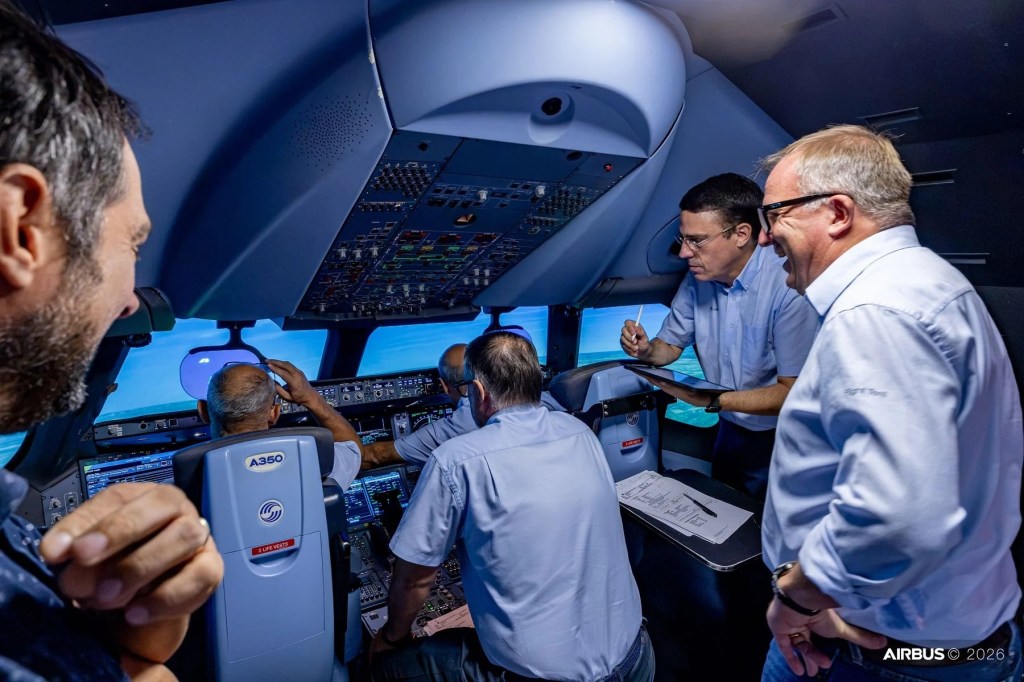
Earlier in 2026, the manufacturer completed what it calls a Virtual First Flight (VFF), designed to clear the aircraft’s new systems, validate flight control laws, and evaluate its behavior under “specific systems failure combinations.” A simulator was connected to real avionics systems test benches, including the A350F’s actual flight controls and digital engine control systems. Bussiere said the setup is “90 percent representative of the physical aircraft.”
The VFF campaign comprised 13 simulation sessions lasting approximately five hours each.
“This allows the team to assess failure criticality, determine appropriate reactions, and decide whether existing A350-1000 procedures…need to be adapted,” Bussiere said. “The only significant variable left to prove in the sky is the freighter’s specific aerodynamic model.”
What’s New on the A350F?
The freighter’s combination of advanced aerodynamics, weight-saving materials, carbon airframe, and Rolls-Royce Trent XWB-97 engines is intended to offer 20 percent lower fuel burn and carbon emissions versus aircraft it is designed to replace. With a range of about 4,700 nm, it would be capable of flying from Hong Kong to Anchorage, Alaska, at its full payload of 111 metric tons (nearly 245,000 pounds). A flight crew rest compartment with two beds will give pilots space to relax on long journeys.
The A350F’s massive cargo door is designed to fit everything from small e-commerce shipments to oversized cargo such as large aircraft engines, as well as items requiring temperature control.
The type will be capable of using up to 50 percent sustainable aviation fuel (SAF) at launch, but Airbus aims to increase that to 100 percent by 2030.
Airbus entered 2026 with 81 next-generation freighters on order but as of August had orders for 115 from at least 14 customers. The largest order is from Atlas Air with 20, followed by Air China Cargo and Cathay Pacific.
The A350F will rival Boeing’s upcoming 777-8F, which has 81 confirmed orders and is also targeting a 2027 service entry. The 777-8F is designed to carry slightly more cargo and fly 300 nm further than Airbus’ design.