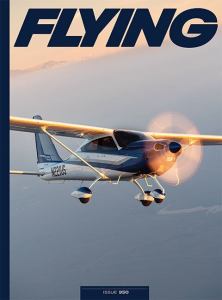
A converted Cessna 208 Grand Caravan equipped with autonomy technology completed what its owner, Joby Aviation, said was the first fully autonomous, coast-to-coast journey across the U.S.
Joby, which has spent most of its existence developing a piloted eVTOL air taxi but in recent years began exploring autonomy, said Friday that the Caravan covered almost 3,200 miles on the journey from California to North Carolina, which began earlier in September. The company said the aircraft’s onboard human safety pilot made zero control inputs during the multi-leg mission, marking a new capability milestone for its proprietary technology.
Instead, the aircraft’s autonomous taxi, takeoff, cruise, route navigation, and landing functions were observed and supervised remotely from Joby’s autonomy headquarters in California and Shaw Air Force Base (KSSC) in South Carolina. At one point, more than 2,300 miles separated the aircraft and its supervisors. Joby said the Caravan autonomously rerouted around storms and other severe weather “without prior airport familiarity.”
The cross-country jaunt culminated in a low pass of Bodie Island Lighthouse near Kitty Hawk, which Joby said paid homage to the Wright brothers’ first powered flight there.
“Autonomy has an important role to play in the future of flight, allowing us to connect remote communities, deliver critical supplies, respond faster to disasters, support military operations, and keep pilots out of harm’s way,” said JoeBen Bevirt, founder and CEO of Joby, in a statement.
The converted Caravan’s eastbound journey included stops in four states. Soon, it will begin its return trip to California and visit seven states, giving eagle-eyed aviators another chance to spot it.
Joby’s Autonomous Caravan
J208 is Joby’s name for the Caravan that recently flew coast to coast. It combines the single-engine turboprop’s airframe with autonomous systems initially developed by Xwing and acquired by Joby in 2024. The venerable Caravan has become a popular airframe for testing autonomy, with competitors such Merlin Labs and Reliable Robotics also using it.
“In practice, the J208 operates under a supervised autonomy model, where a ground-based remote pilot serves as pilot in command, supervising the flight, updating flight plans and managing air traffic control (ATC) communications using the aircraft’s standard radios,” Joby said in a news release earlier this month.
It added that a monitoring pilot is on board for “select operations.”
Joby believes equipping autonomy on an already-certified aircraft will allow it to deliver quickly and at scale. It bills the converted Caravan as an asset for logistics missions including commercial freight, medical transport, disaster response, and defense. In the future, the company hopes to add the same autonomous technology to its commercial eVTOL model.
The defense application may be the first to materialize.
Joby said Friday that its autonomy systems have powered more than 400 flights and 800 automated flight hours in controlled and uncontrolled airspace. That includes participation in three U.S. military exercises spanning thousands of miles across military bases and public airports within the continental U.S. as well as Hawaii.
In August 2025, the Caravan flew more than 7,000 nm and completed a successful Pacific Ocean crossing. Some activities were monitored from nearly 4,000 miles away in Guam. The goal was to show how an autonomous model could efficiently handle high-risk, low-volume airlift and delivery operations.
Among militaries worldwide, there is rising interest for aircraft that could more safely and efficiently conduct logistics and sustain forces in regions such as the Indo-Pacific, where operations are spread across hundreds of miles of ocean. The U.S. Air Force’s Agile Combat Employment (ACE) effort seeks low-cost, attritable aircraft for contested logistics in that region. In 2025, the Air Force shared plans to test another autonomy-equipped Caravan, developed by Reliable Robotics, and eventually deploy it on real overseas missions.
Caravan manufacturer Textron Aviation on Monday unveiled a SkyCourier UX concept aircraft that would integrate Merlin’s Pilot autonomy system and serve similar applications.
What’s Next?
J208’s trip from California to North Carolina was just the first half of what Joby described as a monthlong, coast-to-coast tour spanning 10 states.
The Caravan departed California’s Buchanan Field Airport (KCCR) on September 10. Its first stop was Phoenix Deer Valley Airport (KDVT) in Arizona, where it demonstrated potential applications for defense, first responders, and cargo. Joby said the activities were part of the Utah-led portion of the FAA’s eVTOL Integration Pilot Program (eIPP), which is studying airspace integration in high-altitude terrain and extreme desert temperatures.
Next was a visit to Fort Worth Alliance Airport (KAFW), where a demonstration highlighted the model’s autonomous freight capabilities. That coincided with Joby’s first eVTOL flight under Texas’ eIPP project.
At Shaw Air Force Base, J208 conducted a “capability demonstration of representative military flight operations and tactical defense readiness,” Joby said. It then landed at Dare County Regional Airport (KMQI) in North Carolina.
The aircraft’s first westbound stop will be at Raleigh-Durham International Airport (KRDU) on Wednesday. Joby said the North Carolina flights will support that state’s eIPP activities and show how autonomy could improve aerial deliveries of emergency and medical supplies to remote locations.
J208 will also visit Stafford Regional (KRMN) in Virginia, Louisville Muhammad Ali International (KSDF) in Kentucky, Wichita Dwight D. Eisenhower National (KICT) in Kansas, OKC Will Rogers International (KOKC) in Oklahoma, Salt Lake City International (KSLC), and Portland International (KPDX) in Oregon. The last three stops will again be part of the Utah-led eIPP project.
Joby said the aircraft’s stop in Portland will include both flight demonstrations and static displays, giving curious aviators an up-close look. Readers can track the journey on Joby’s website.