
The National Transportation Safety Board on Wednesday issued a new safety alert urging general aviation pilots and owners to inspect and replace certain seat restraints in order to lower the risk of injury or death during aviation accidents.
Among the NTSB’s findings is that pilots may unknowingly be using restraint systems that offer a lower level of protection during an accident because the FAA has permitted the use of systems that comply with earlier, less stringent performance requirements. The agency also noted that serious or fatal injuries can occur during accidents when restraints are not installed or fail due to UV exposure, age, or repeated use.
To combat these potential hazards, the NTSB recommends that pilots and mechanics frequently inspect lap belts and shoulder harnesses, understand how to ensure they are in safe condition, check their rated strength, and replace or install new restraints when necessary.
The NTSB last issued an aviation-related safety alert in January 2026 describing how ballistic parachute recovery systems can pose hazards to first responders at an accident site.
Varied Restraint Performance Requirements
According to the NTSB’s safety alert SA-108, certain GA aircraft may be equipped with seat restraint systems that do not meet the FAA’s latest performance requirements.
Technical Service Order (TSO)-C22f, issued in 1972, required newly manufactured lap belt restraints to have a rated strength of 1,500 pounds. In 1993, the FAA replaced that order with TSO-C22g to “better account for dynamic human movement and upper torso forces,” per the NTSB. The latter order required lap belts and shoulder harnesses to have rated strengths of 3,000 and 2,500 pounds, respectively.
However, the regulator permitted small aircraft weighing 12,500 pounds or less to use restraints approved before TSO-C22g’s issuance, citing economic reasons.
“As a result, pilots and mechanics may unknowingly be using safety restraint systems that may offer a lower level of protection during an accident than systems that comply with the enhanced performance requirements of TSO-C22g,” the NTSB said.
For example, the NTSB’s investigation into the 2023 crash of an Aeronca 7CCM Champion found that the airplane’s upper torso restraint and shoulder webbings had a rated assembly strength of 1,500 pounds, which satisfies the FAA’s 1972 order but not the ’93 update.
The Champion suffered substantial damage, and the pilot and passenger were killed. Examination of the wreckage determined that the torso restraint’s threading at the connection to the airframe was separated and found evidence of separation at the Y-junction connecting the two shoulder straps.
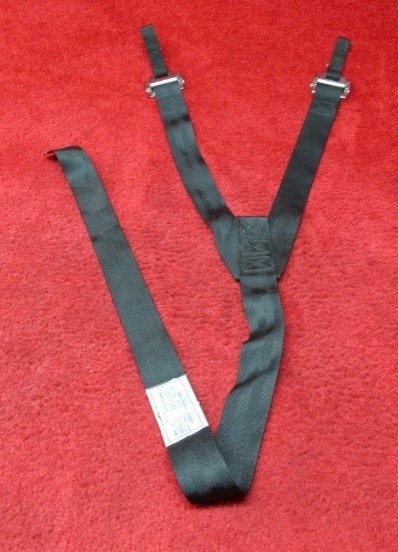
In another 2023 accident, the NTSB found that both seats of a Cessna 172N that crashed near Madison County Airport (KUYF) in Ohio used three-point restraints meeting only the less stringent FAA order. A flight instructor and student pilot died in the accident. Similarly, the agency found that the upper torso restraint’s threading was separated.
NTSB Urges Greater Vigilance
The NTSB said GA owners and operators should be aware that they may be flying with restraints that do not meet the FAA’s latest requirements. It urged them to replace those rated below 3,000 pounds for a lap belt and 2,500 pounds for a shoulder harness. The agency also recommended replacing restraints whose strength rating cannot be verified due to missing or unreadable labels. The manufacturer or a mechanic can check the rated strength if the owner or operator is unsure of how to do it.
Also critical are routine preflight and annual visual inspections of the shoulder and lap belt restraints to check for signs of degradation. The NTSB emphasized that “special attention” should be given to the condition of Y-junction shoulder harnesses.
Highlighting the importance of inspections, the agency cited a 2005 accident involving a Taylorcraft F-19 where the pilot died after the airplane crashed. His shoulder harness, which investigators found showed evidence of tensile overload, failed. The passenger’s restraint system was found to be intact, and they suffered serious but nonfatal injuries.
The NTSB also referred to a Survival Factors Factual Report on the fatal 2012 crash of an Aeronca 7AC Champion in which the accident airplane suffered shoulder harness failures. It includes details of three new restraints compliant with the FAA’s 1993 order but shown to fail below the rated strength of 1,500 pounds in testing.
Chapter 9 of the FAA’s Advisory Circular 43.13-1B provides inspection guidance for safety belts. The agency’s Special Airworthiness Information Bulletin 2026-10R1 describes the safety risks of defective torso restraints and safety belts on GA aircraft.
The NTSB also urged GA owners and operators to install shoulder harnesses on airplanes designed without them. They could do so using a supplemental type certificate (STC) or other FAA-approved method described in the agency’s ACE-00-23.561-01 policy statement.