“In the airplane, I’m not your daughter. I am not 15 years old. You are not teaching me how to drive. I am pilot in command. Am I clear?”
That’s how the passenger briefing I gave my father began. I was a 203-hour private pilot at the time and flying twice a week, building up my cross-country time in pursuit of the instrument ticket. Dad was not a pilot. He was a retired aerospace engineer and military man.
With the checklist in hand, I did the preflight inspection of the Cessna 152. I made sure Dad understood the sterile cockpit and how to work the seat belts and doors and to keep hands and feet away from the controls, and that when I raised my hand I had to talk on the radio and he needed to be quiet.
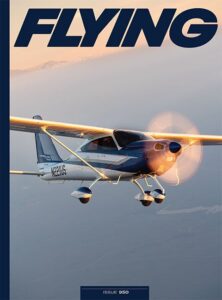
If you’re not already a subscriber, what are you waiting for? Subscribe today to get the issue as soon as it is released in either Print or Digital formats.

Dad was visiting from California. I planned a route that took us over the Puget Sound in Washington state and airports the military used during World War II, and two installations still in use—one of which Dad helped build as a young man. That flight is one of my fondest memories of him, and judging by how many times he shared the story of that day with people, I’d say it was one of his favorite memories of me.
But it wasn’t the beauty of the Sound as seen from the air that he remarked on. It was the passenger briefing. Dad, who I am convinced was the inspiration for Captain von Trapp in the movie adaptation of The Sound of Music, appreciated the no-nonsense approach to it.
- READ MORE: Military Influence Can Be Felt All Over General Aviation
- READ MORE: How Pilots Can Prepare for Unexpected Power Loss
I share this story with my learners when they express trepidation about taking up a parent as a passenger. It can be challenging to be PIC when the passenger is your parent. It can also be a challenge when the person you’re flying with is not a pilot and in a position of authority, like your employer or an older sibling. You need to establish rules before you leave the ground.
Accept the Responsibility
Per the FARs, the PIC is the person who:
• has final authority and responsibility for the operation and safety of the flight;
• has been designated as pilot in command before or during the flight; and
• holds the appropriate category, class, and type rating, if appropriate, for the conduct of the flight.
This means you’re the one responsible for the passenger safety briefing. It is amazing how many people skip this, sometimes with unfavorable results. In the National Transportation Safety Board (NTSB) reports, you sometimes find mention of passengers who were badly injured because they did not know how to operate the seat belt or door and had difficulty egressing from a burning aircraft.
Timing the Safety Brief
In my experience, the safety brief is best conducted standing outside the aircraft. Even sitting inside one can be distracting. Explain how to fasten and unfasten the seat belt and open the door, and best practices for exiting the aircraft. If you did a good job, they should be able to put on and adjust their seat belts. Make sure of this, and show them how to put on the headset and place the mic boom correctly.
If there is a fire extinguisher in the aircraft, point it out, and use a remark like, “Be careful not to trip over the first extinguisher.” Don’t use the words “crash” or “fire” because that’s all they will hear, and it can be frightening.
Once the passenger(s) are seated inside, reinforce the briefing by assisting them with seat placement, seat belts, headsets, and the door latches. Make sure they are properly belted in, and don’t forget the shoulder harness. Beware of the “car transference” phenomenon, when they struggle with the seat belt and door because they are used to a car that uses push-button mechanisms rather than a lever-style seat belt and lift-latch door handle.
Be extra cautious about who you allow in the front seat and warn them not to grab the stick or yoke for leverage when they want to pull their seat forward during the flight. It helps to have them perform the seat wiggle to make sure it is locked in tight before putting their seat belt on.
Warn the passenger(s) not to try to peel the placards or stickers off the panel. This is a weird, nervous habit for some people. Explain that these placards serve a purpose and are not there for decoration. Ask them not to touch anything in the cockpit without express permission and explain that when the aircraft is in the pattern for either takeoff or landing, you will be task saturated, so do not engage in idle chatter. If you put your hand up, that means you need to listen to a radio call, and everyone in the cockpit needs to be quiet.
Share, Don’t Scare
What is normal for pilots is not normal for non-aviators, so it is often in your best interest to explain what you are doing and why as you are doing it. This doesn’t mean giving a full-on flight lesson. Rather, let them know that the turbulence is caused by thermals rising from the warm ground, and it will be less over the water where the air is cooler. And, no, you don’t need an air traffic control tower at the airport to be safe. And you’re turning this way or that way to create more space between you and the aircraft ahead of you, etc.
Although there isn’t an FAR prohibiting a non-pilot passenger from taking the controls, my personal rule until I became a CFI was that no passenger was allowed to do this. I did this after hearing so many stories from pilots who were not instructors allowing a non-pilot passenger to take the yoke or stick and suddenly finding themselves in an unusual attitude when the passenger attempted to do a video game-like move.
Stress to your passenger not to touch the throttle and mixture knobs as they belong to the pilot only. You probably know someone who experienced an uncommanded loss of engine power when the front-seat passenger pulled the red mixture knob after asking, “What does this do?”
It is no fun if the passenger becomes queasy. You can help prevent airsickness by admonishing your passengers not to look through the viewfinder of their camera if they are filming or taking photos. That’s a surefire way to induce sickness. Instead, hold the camera at a wide angle.
Keep Ziploc bags or small trash-can liners within reach in the event a passenger does start to feel airsick. Always have a bag at the ready. You can help prevent airsickness by encouraging them to keep their eyes on the horizon and outside the aircraft, looking for windmills on ridgelines, a water tower in the distance, etc. You may also want to issue mint gum or Tic Tacs. It doesn’t matter if they have flying experience or not, it can happen to the best of us.
Help Them Help You
Passengers often enjoy the flight more if they are involved. Explain to the passengers how they can help you spot traffic and what information you need beyond “I see an airplane!” “Traffic at 2 o’clock, same altitude, and heading away” or “Traffic at 10 o’clock, below, crossing left to right” works much better.
Establish early where you are going to go on that first flight. If there is a particular landmark, like a corn maze or a high school football field, use that. Or if the passenger is local, they might get a thrill flying over their house. Be mindful of appropriate altitudes during the flight, and be extra cautious when operating in practice areas and along VFR flyways.
For the first-time passenger, a flight of no longer than 1.2 hours is a good length. Pilots often forget how fatiguing flying can be—the noise and vibration can take their toll. If the passenger becomes ill or is frightened, it’s time to turn back and land. You are not there to impress anyone—you’re there to demonstrate your ability to conduct a safe flight.
This column first appeared in the March Issue 968 of the FLYING print edition.