
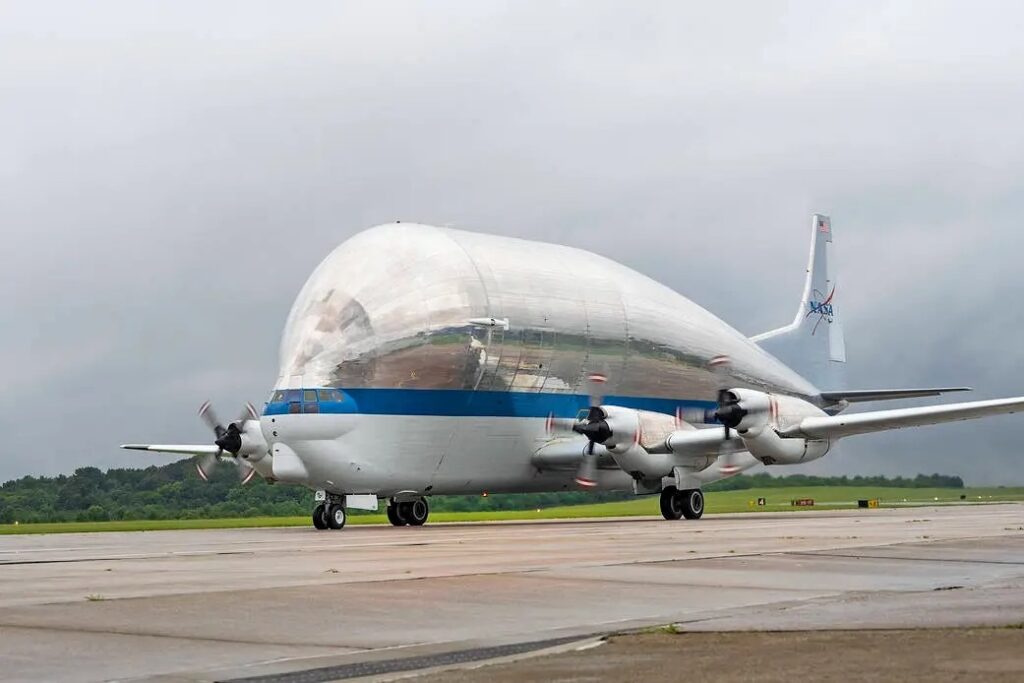
Aero Spacelines’ B-377-SGT Super Guppy—a Beluga whale-shaped aircraft designed to carry loads too large or bulky for narrow roads, railroad tunnels, or low bridges—is one of history’s rarest and most unique aircraft. You’ll have a chance to see it firsthand in April, when the last airworthy Super Guppy heads to Lakeland, Florida, for this year’s Sun ’n Fun Aerospace Expo.
The Super Guppy will be on static display from April 14-19 as part of NASA’s exhibit at the event, which will also include a T-38 Talon supersonic trainer used to prepare astronauts for missions to low-Earth orbit and beyond. NASA Administrator Jared Isaacman plans to speak Thursday after arriving with the trio of F-5 Tiger fighters he owns.
Beyond Isaacman—whose recent overhaul of NASA’s Artemis program is sure to attract a crowd—the star of the show will be the Super Guppy.

The aircraft’s cargo hold is so large it can transport two T-38s at once. Though several aircraft top its useful load of 45,000 pounds, only a handful match its internal volume, which measures an astounding 111 feet long and 25 feet wide. It cruises at about 250 mph, with a range of 1,700 nm and service ceiling of 25,000 feet.
In the early days of the space race, NASA used barges to ship rocket parts through the Panama Canal or Gulf of Mexico to Cape Kennedy (now Cape Canaveral) in Florida. That changed in 1961, when Aero Spacelines introduced its first Guppy. Built around a heavily modified KC-97, the “Pregnant Guppy” boasted the largest cargo compartment of any aircraft at the time at over 19 feet in diameter. It was specifically designed to transport Saturn rocket stages for the Apollo program.
Aero Spacelines in 1965 introduced the Super Guppy, which added even more cargo space, more powerful engines, a pressurized cockpit, and a hinged nose for front loading. NASA purchased the aircraft in 1979 and flew it more than three million miles across more than three decades, supporting the Apollo, Skylab, Gemini, and International Space Station (ISS) programs.
The manufacturer produced only four B-377-SGTs or Super Guppy Turbines, the last generation of the Guppy. Airbus used the SGT, featuring upgraded Allison T-56 turboprops, to ferry A300 fuselage sections across Europe from the 1970s to the ’90s. NASA acquired one of them after Airbus retired the model to museums in 1997, replacing its older Super Guppy.
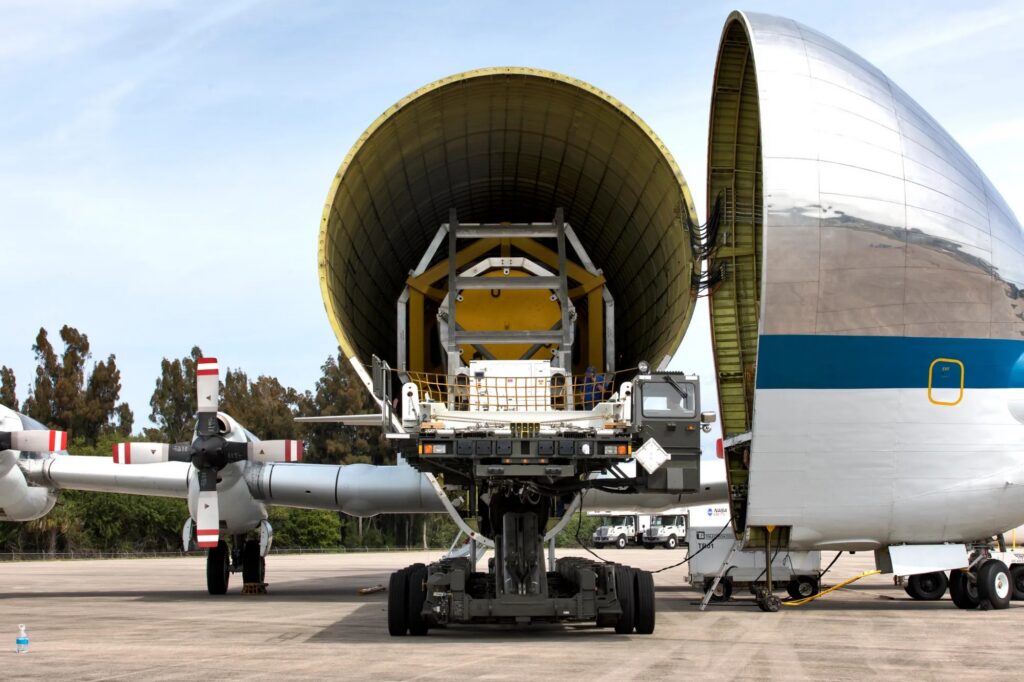
In addition to other aircraft, NASA uses the Super Guppy to transport the heat shield and other elements of Orion and its Space Launch System (SLS)—the crew capsule and launch vehicle for the Artemis moon missions. It also moves T-38s for the U.S. Air Force and V-22 Ospreys for the Navy.
In November, the Super Guppy was spotted flying for the first time since July 2024. On Thursday, it made an out-and-back flight at El Paso International Airport (KELP) in Texas.
Blast Off With NASA at Sun ’n Fun
The Super Guppy will be on display for the entirety of Sun ’n Fun. David Elliott, manager and lead flight engineer for NASA’s Super Guppy program, will discuss his experience flying and loading the gargantuan aircraft on Tuesday at 10 a.m. EDT.
The T-38 will be on display from Wednesday through Saturday. In addition to training astronauts, NASA uses the supersonic jet for various mission support tasks, such as capturing high-speed imagery as it flies in front of the sun.
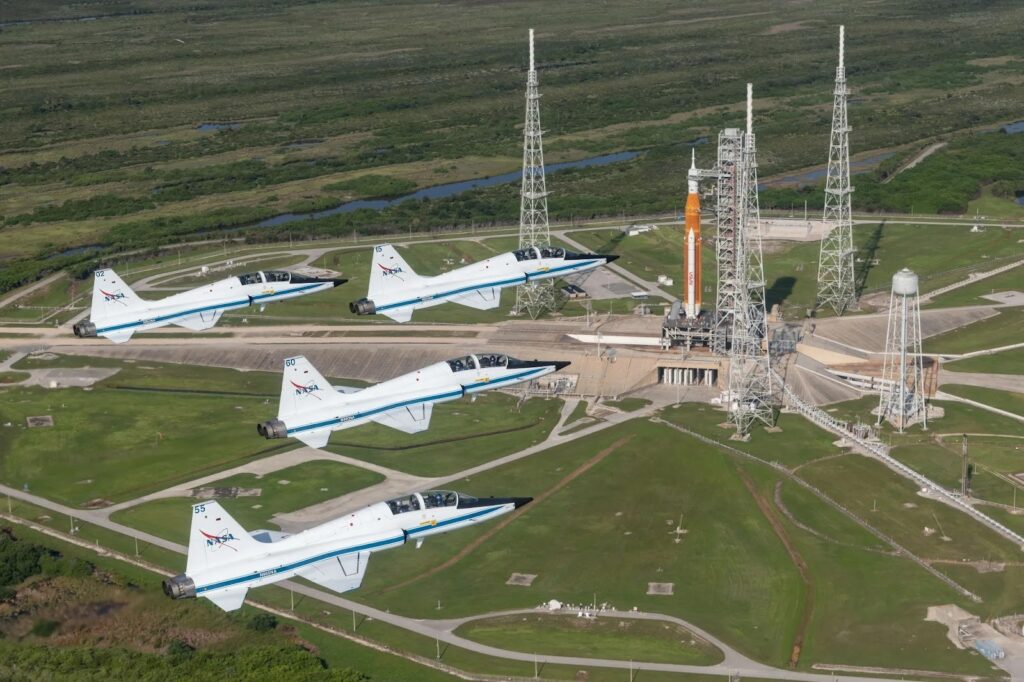
Isaacman will fly into Lakeland on Wednesday in one of the three F-5s, which are painted in red, white, and blue in honor of America’s 250th anniversary celebration. The NASA chief—who also holds certifications for the T-38, Douglas A-4 Skyhawk, Aero L-39 Albatros, and other models—has been flying high-performing NASA personnel on “employee incentive flights” in the F-5s since January.
Isaacman will speak at noon EDT Wednesday about America’s return to the moon under the Artemis campaign, which NASA this week updated with plans to build a permanent moon base. The space agency is targeting Wednesday for the launch of Artemis II, the first crewed mission on the manifest. Artemis II will send four astronauts further from Earth than any human has been before, serving as a test run for lunar landing attempts planned for 2028.
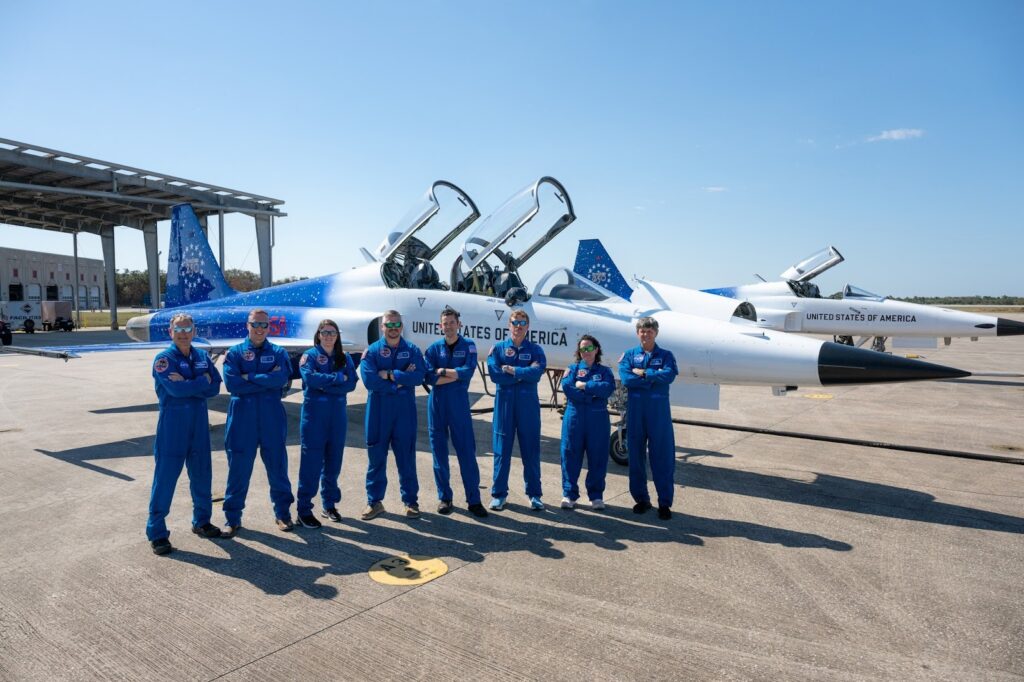
Aldora Louw, who leads NASA flight operations, will discuss astronaut spaceflight readiness training on Thursday. On Friday, NASA research pilot Sean Brady will recount his experiences flying NASA aircraft.
There will be other opportunities to see NASA’s fleet up close. In addition to Sun ’n Fun, the space agency in 2026 plans to bring aircraft to EAA AirVenture in Oshkosh, Wisconsin, the Pacific Air Show in California, Wings Over Houston, and America’s 250th birthday fireworks celebration and Freedom 250 Grand Prix in Washington, D.C.
Per materials shared publicly by NASA, the campaign will further include flyovers of “launches” and “major sporting events.”
Beyond the Super Guppy, T-38, and F-5s, attendees of those events could see the space agency’s heavily modified Lockheed U-2s, flying for NASA as ER-2 high-altitude research aircraft. Also part of the traveling fleet will be F/A-18 Super Hornets and WB-57 research aircraft, built off of the Martin B-57 Canberra.