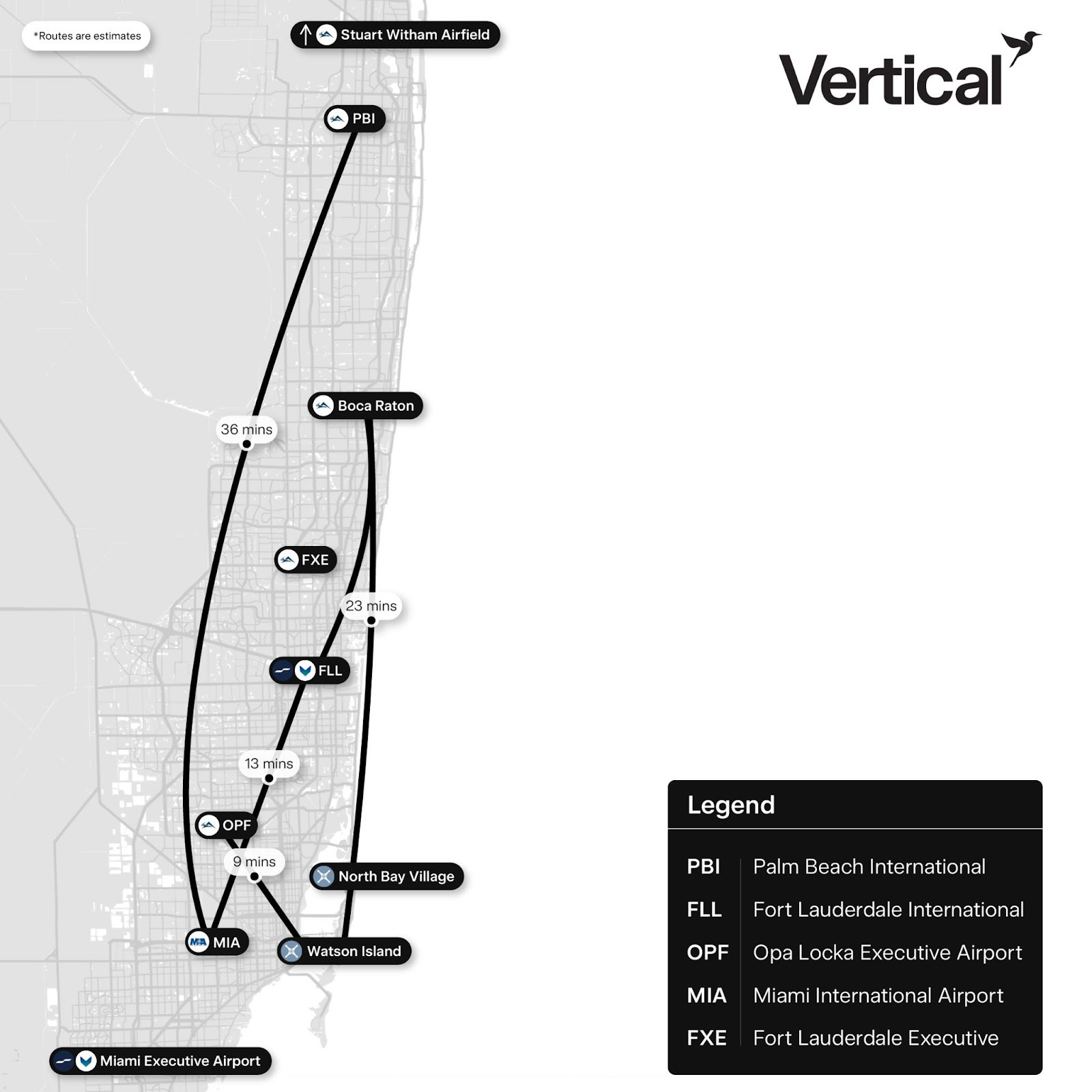
The U.K.’s leading developer of electric vertical takeoff and landing (eVTOL) aircraft—which earlier this year unveiled a planned New York City air taxi network—this week revealed it is targeting a second U.S. network on the west coast of South Florida.
Vertical Aerospace on Wednesday said it is working with partners to bring its electric and hybrid-electric aircraft to Miami, Palm Beach, Fort Lauderdale, and other residential, business, and event hubs in the area. The company will host a free public display on Tuesday and Wednesday at the Bass Museum in Collins Park, Florida, giving prospective flyers a firsthand look at its flagship Valo air taxi.
“As electric aviation moves closer to commercialization, we are working with our customers and operating partners to deliver real-world connections that are faster, cleaner, and designed around the passenger,” said Stuart Simpson, CEO of Vertical, in a statement.
Vertical in January displayed Valo at the Classic Car Club Manhattan in New York City, where visitors were allowed to sit inside the aircraft’s four-seat cabin.
At the event, Michael Cervenka, Vertical’s chief commercial and technology officer, told FLYING that Valo’s cabin is large enough to one day accommodate six seats, giving the company an edge over U.S. competitors. Joby Aviation, Archer Aviation, and Boeing’s Wisk Aero are building air taxis for four passengers, and Beta Technologies for up to five.
“Plenty of people have sat in Joby or Archer’s aircraft,” said Cervenka. “When they come and actually sit in this, they’ll just see it’s a completely different proposition.”
What Is Valo?
Valo, which Vertical unveiled in December, is designed to fly 100-mile, all-electric trips while cruising at about 150 mph and 2,000 feet agl.
At launch, its pilot will fly up to four passengers or 1,200 pounds of cargo, with a hold large enough for six checked and six carry-on bags. Panoramic cabin windows and a cockpit divider are designed to improve passenger comfort and safety.
Valo’s underfloor battery system comprises eight liquid-cooled packs, each powering a carbon-fiber composite vertical propeller. Four of these tilt forward to support cruise flight. The electric propulsion system is designed to produce about 50 dBA of noise during cruise, which Cervenka estimated is 30 times quieter than a helicopter.
Flight controls comprise a simple joystick, three flight computers, and Honeywell’s Anthem flight deck and digital fly-by-wire system.
“The pilot’s not really flying the aircraft,” said Cervenka. “The pilot’s essentially telling the aircraft, ‘This is where I want to go.’ So if I want to go up, I just pull the right stick backwards. If I want to hover, I just let go of everything.”
Vertical estimates it has about 1,500 preorders for the Valo, including from American Airlines, Japan Air Lines, Héli Air Monaco, and Bristow Group—its operating partner in New York City and across the Atlantic in the U.K. It aims to launch commercial operations in 2028 after securing U.K. certification.
The company is also developing a hybrid-electric variant with a range of up to 1,000 miles. Future Valo configurations could include cargo, defense, emergency medical services, hybrid, or autonomous.
Air Taxis in the Sunshine State
In South Florida, Vertical believes Valo could cut a 65-mile, 90-minute drive between Miami International Airport (KMIA) and Palm Beach International Airport (KPBI) to about 36 minutes. A “regional city link” between Miami International and Fort Lauderdale-Hollywood International Airport (KFLL) could be flown in an estimated 13 minutes.
“MIA and our general aviation airports are some of the busiest airports in the country for private aviation, which makes Miami-Dade County the perfect launch site for AAM,” said Daniella Levine Cava, mayor of Miami-Dade County.
Another potential route could link Miami’s Watson Island Heliport—the closest landing zone to Miami Beach—and Miami-Opa Locka Executive Airport (KOPF) in about nine minutes. Vertical said the connection would be “ideal for major events, cruise departures, and waterfront.”
Valo could cover the 42 miles between Watson Island and Boca Raton Airport (KBCT) in about 23 minutes, Vertical said, quickly flying passengers from Miami Beach to Boca’s business, golf, and residential communities.
“Imagine landing near Fort Lauderdale and reaching your tee time without touching I-95,” said Simpson. “Leaving Miami for Palm Beach after lunch and being back for sunset. Or taking a quiet electric flight over Biscayne Bay as the skyline turns gold.”

A map shared by Vertical includes additional hubs at Miami Executive Airport (KTMB) and Fort Lauderdale Executive Airport (KFXE). Working with Skyports, which has already announced plans to electrify the Watson Island Heliport, it could add the vertiport developer’s planned North Bay Village location. Also depicted is Vertiports by Atlantic’s (VBA) project at Witham Field (KSUA).
Vertical’s planned South Florida service has some overlap with the Miami-based air taxi network Archer announced last year, which similarly includes VBA-built facilities at Withan Field, KPBI, KBCT, and KFXE. Beyond VBA and Skyports, Vertical said it is working with a joint venture formed by vertiport developer UrbanV and FBO network Signature Aviation, with potential sites at KFLL and KTMB.
Skyports’ Downtown Skyport—operated jointly with Groupe ADP since April after the partners acquired, renamed, and began electrifying the Downtown Manhattan Heliport—is the planned hub of Vertical’s New York City network. Connections could include John F. Kennedy International Airport (KJFK) and East Hampton Airport (KJPX) on Long Island, as well as Newark Liberty International Airport (KEWR) and Teterboro Airport (KTEB) in New Jersey.
Vertical said that in addition to being a “major global aviation hub,” South Florida provides a “gateway” to Latin America and the Caribbean. That, it said, makes it a “compelling market for potential future regional electric operations.”