
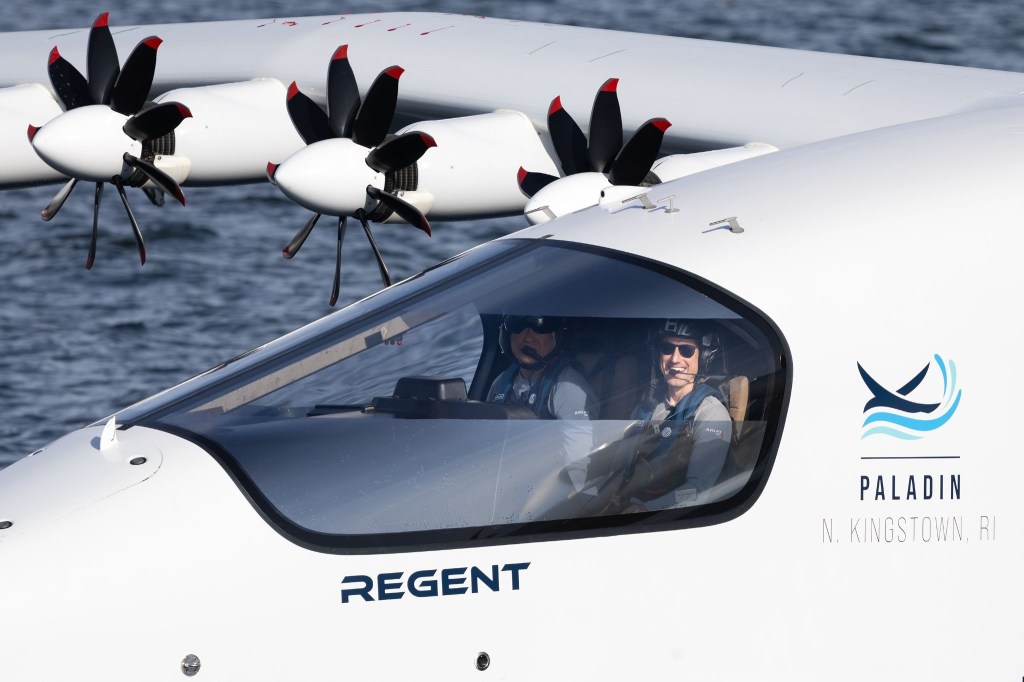
Regent Craft said Wednesday that its prototype electric seaglider, Viceroy, made its first human-crewed flight. According to the Rhode Island-based manufacturer, Viceroy—which combines aspects of traditional aircraft and maritime vessels—is the largest all-electric, wing-in-ground effect (WIG) craft to fly with people on board.
Regent said two captains took the prototype out on Rhode Island’s Narragansett Bay. Categorized as a Type A WIG craft and defined as a maritime vessel, the model is designed to be operated by maritime captains who secure a type rating after completing a training course. It will be certified and regulated by the U.S. Coast Guard rather than the FAA.
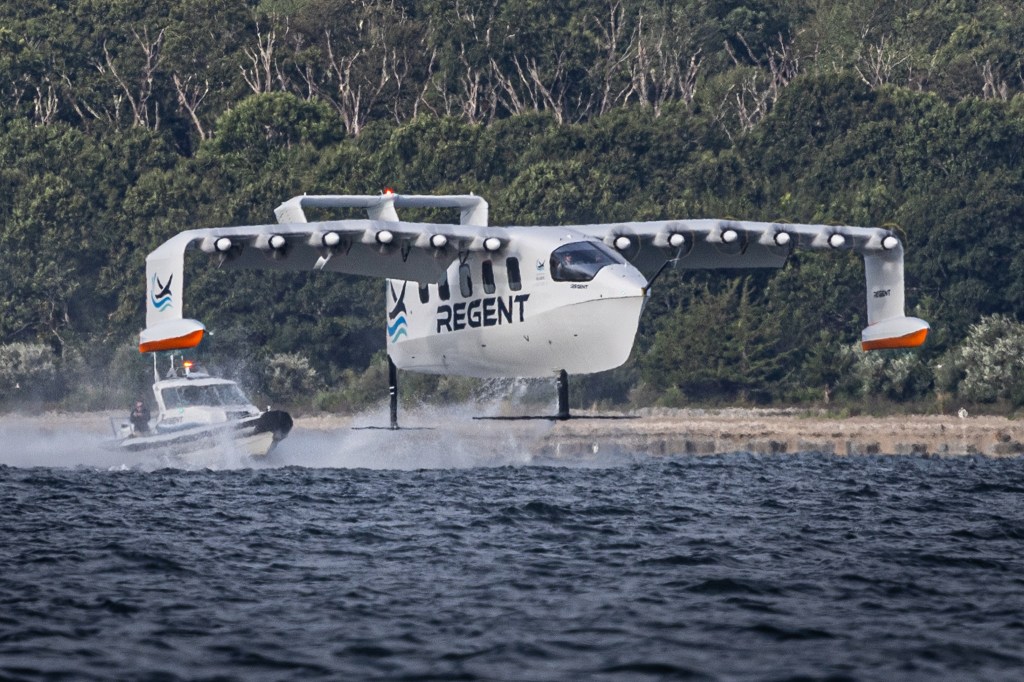
The manufacturer said Viceroy flew 33 feet above the water for about 30 seconds, covering 1,956 feet. That distance equals the height of the world’s largest radio and television broadcast towers. Regent said the flight marks the prototype test program’s final stage of sea trials.
Billy Thalheimer, co-founder and CEO of Regent, said the sortie “marks the start of a new era in mobility, unlocking opportunities across passenger travel, defense missions, and cargo transport.”
Mike Klinker, co-founder and chief technology officer, added that the flight “gives us the confidence to move into full-rate production.”
Viceroy’s first human-crewed flight was a long time coming. Regent in August 2024 received Coast Guard approval to begin testing prototypes in Narragansett Bay and Rhode Island Sound. It communicated throughout 2024 that it aimed to begin crewed testing by year’s end.
Regent did not begin full-scale Viceroy prototype flights until the following year. It predicted the vessel would fly with humans by the summer, but that did not come to fruition, either.
WIG seagliders have been studied by government entities such as the U.S. Defense Advanced Research Projects Agency (DARPA)—which explored the Liberty Lifter—as well as by China and Iran. Building a vessel that is viable for long-term commercial, recreational, or military use has proven challenging.
Regent on Wednesday, however, said Viceroy is the first WIG craft that is “engineered and readied for commercial and defense operation at scale.”
Regent’s Viceroy Seaglider
Viceroy is intended for zero-emission coastal travel with two crew and up to 12 passengers. It combines hydrofoils—essentially underwater aerofoils—with autonomous control systems, sensors, and blown-lift propulsion technology. The idea is to combine the speed of an aircraft with the functionality and low-cost operation of a boat.
The model’s only controls are boat controls. It is commanded using a single lever thrust control and fly-by-wire system, with digital interfaces displaying moving maps, radar, traffic advisories, and other information. Stability and certain maneuvers, such as landing, are augmented by a proprietary autonomous digital control system. Regent claims the system “offers a level of safety and control that no WIG craft has achieved before it.”
Over open water, the hydrofoils retract into the vessel’s deep-V hull, allowing it to fly in ground effect within one wingspan of the water’s surface. It can also rise up on its foils for a smoother, more controlled ride near harbors or float like a boat at docks and marinas. Propellers, powered by redundant electric motors, provide propulsion.
At launch, Viceroy will have a range of about 180 sm (156 nm). Regent’s first U.S. launch customer, luxury coastal travel operator The Twenty Five, said it could open up routes including Boston to Nantucket, Massachusetts, in one hour or Palm Beach to Miami, Florida, in 40 minutes. As battery capacity improves, the range could rise to 500 sm (436 nm).
Per The Twenty Five, the first electric seaglider deliveries are expected in 2027. Regent in August raised $240 million that Thalheimer said will help the company “execute key certification milestones” as well as scale manufacturing. The company is working with Lloyd’s Register and other partners to enable operations outside the U.S. in places such as Japan.
Regent in June completed a 255,000-square-foot electric seaglider production facility in Rhode Island that it said will anchor global manufacturing for Viceroy. It described the waterfront site as the world’s first production hub for WIG craft. On Wednesday, the company said the facility will come online in 2026.
Regent is also developing an autonomous, hybrid-electric variant of the Viceroy, as well as a military model called the Squire, which made its first ground effect flight in April. The manufacturer is collaborating with the U.S. Marine Corps under contracts worth about $15 million.