
It was in the middle of a flight to explore the capabilities, handling, and operating envelope of the Cirrus SF50 G3 Vision Jet that it happened.
Ensconced at FL 220, a modest height for a jet with a max operating altitude of FL 310, with the features of the Garmin Perspective Touch+ automation gracefully keeping the aircraft in the proper groove in the sky, I finally had time to simply look around and enjoy the experience. My overall impression was that the large flight deck and cabin windows allowed me to see much more of the sky, the world, and the airframe of this jet than I ever have in an airplane that didn’t have a bubble canopy.
The air was dead smooth, and despite a ground speed north of 300 knots, it felt as if the flying machine were suspended in the sky, with the earth turning beneath us. I was seated as comfortably as I have been in any aircraft, savoring the extent of the view when it hit me.
If you’re not already a subscriber, what are you waiting for? Subscribe today to get the issue as soon as it is released in either Print or Digital formats.
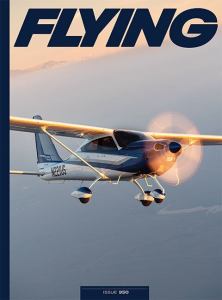
I was on a magic carpet, every bit as luxurious and capable as those of ancient tales. All that remained was for adventures to begin as it carried me forward.
Vision Jet Development
How did a general aviation manufacturer get here, delivering over 700 of the first general aviation, single-engine, single-pilot personal jets with the Cirrus Airframe Parachute System (CAPS)?
Cirrus did it the same way musicians get to Carnegie Hall, with practice, hard work, progressive thinking, and a plan for the future. Cirrus succeeded where at least seven other companies did not. Even before the Vision Jet became hopeful drawings, the manufacturer was designing its SR Series (SR20, SR22, SR22T) with flight decks, performance profiles, and sophisticated avionics with the goal of making it realistic for a competent SR pilot with significant IFR experience to step up into its planned but as yet undesigned jet.
In 2007 Cirrus principals Dale and Alan Klapmeier began publicly talking about “the jet” that was being designed in what they called the company’s “Moose Works” in Minnesota. It was to be similar to the SR series and capable of being stored in the same 40-by-40 hangar that could house a Cirrus SR22.
- READ MORE: We Fly: ScaleWings SW-51 Is So Real, It’s Surreal
- READ MORE: We Fly: Pilatus PC-12 Pro
An early prototype was flown in 2008, a bad time for general aviation overall, so it was not until 2014 that there was enough capital to build and fly a conforming prototype. In 2016 the first production SF50 flew, the jet received FAA type-certification, and deliveries began.
Since then, Cirrus has shown that pilots with experience in high-performance, piston-engine airplanes can step up into the SF50, pass the type rating practical exam on the first try, and safely operate the jet in the real world. Cirrus has also made upgrades to the Vision Jet, most notably with the G2 in which it upped its maximum altitude from FL 280 to FL 310, bumped max cruise up to 317 ktas, and installed the Garmin Perspective Touch+ integrated flight deck. Along the way, “Safe Return Emergency Autoland,” Garmin’s Autoland, was added and payload and performance boosted.
G3 Vision Jet Model
In February, Cirrus announced and began deliveries of the G3 Vision Jet with some 30 enhancements, primarily to increase the capabilities of the avionics, visibility of the plane, and comfort for those in the cabin. Without attempting to go into all the G3 improvements, I’ll look at some that grabbed my attention.
From an operational and pilot workload perspective, the ATC Data Link (Cirrus also uses the acronym CPDLC for Controller-Pilot Data Link Communication) system, allowing text communications between a controller and the jet, is way up there in providing support to a pilot. The pilot initiates contact with ATC through the CPDLC and starts receiving clearances, new radio frequencies, altitudes and routes via text message. A tone alerts the pilot to an incoming message. The pilot reads it, decides if it can be complied with and, if so, taps the Wilco and send buttons. If unable to comply, the pilot can say so and explain why, just as we do now via voice—except this is faster. Plus, the message is saved, so the pilot has, for example, the route clearance written out in much better handwriting of their own.
![Ergonomic leather seats are notably comfortable on the Cirrus SF50 G3 Vision Jet. [Credit: Erin Armstrong]](https://www.flyingmag.com/wp-content/uploads/2026/07/Cirrus-interior.jpeg?w=1024)
If desired, the pilot can tell the system to load the clearance into the Garmin automation, setting up the route, initial altitude, and additional information. The pilot then just confirms that everything loaded correctly and activates the change.
En route, a call to change frequencies doesn’t take up airtime, the pilot sees the frequency written (less chance of loading it incorrectly), punches Wilco and send to confirm receipt and compliance, and has the new frequency loaded into the appropriate comm radio in either the standby or active position. It’s delightfully easy, and there’s no back and forth with a controller trying to get the numbers right.
Another new feature is a time-saver anyone operating an aircraft should like—all databases are automatically updated while the Vision Jet is parked with Cirrus IQ Pro Advanced.
Alerts-linked checklists are almost a third hand for a single pilot when something out of the ordinary pops up. In the event the electronic alerting system advises them of an abnormal or emergency event, it also pulls up the appropriate checklist—no more pulling out a thick binder and finding the appropriate one. As the pilot deals with each checklist item, they use the scroll wheel to track and then click on it, and the cursor moves to the next item. That continues until the checklist is complete and the situation has been handled or it’s time to put the jet on the ground—and the electronic checklist provides guidance for that as well.
Having used Garmin’s Taxiway Routing and 3D SafeTaxi in other aircraft, I’m glad to see that safety feature in the Vision Jet.
No matter how many times I’ve gotten into a Vision Jet, I am always mildly surprised how big the cabin is. For the G3, Cirrus has made even better use of the space. Until now, the SF50 could hold five adults and two kids—one adult in the center of the rear bench seat flanked by the two children. All the passenger seating has been reworked. The rear bench seat now holds two adults, one on each end, with space and a restraint system for a child between them. Although the passenger seats still use the same attach points, they have been upgraded in a fashion that gives 2 inches more legroom for the rear seat and smoother operation of the middle seats. Use of new foam makes what I always thought were comfortable seats even more so.
As Cirrus was developing the SF50, it was also considering appropriate training for the required type rating. If it’s a jet, the PIC must have a type rating in it, which involves a check ride to ATP performance standards with an examiner satisfactory to the FAA.
Planning for pilots stepping up from its SR series, Cirrus decided to keep the Vision Jet training in-house, at its Knoxville, Tennessee, Vision Center containing two full-motion Level D flight simulators. Cirrus personalizes type training by working with the new owner-to-be beginning several months before the formal type rating training is to begin. Delivery of the aircraft is not tied to the training schedule, reducing pressure during training.
The Basics
Powering the SF50 is a Williams International FJ33-5A jet engine developing 1,846 pounds of thrust. Maximum operating altitude is FL 310, where its max cruise is 317 ktas while burning 65 gph. At that height the pressurization system generates an 8,000-foot cabin altitude.
Maximum ramp weight is 6,040 pounds with maximum takeoff weight 6,000 pounds. The jet I flew had an empty weight of 3,715 pounds—slightly more than the 3,500 shown on the Cirrus website—giving a useful load of 2,325 (the Cirrus website advertises 2,446). Maximum usable fuel is 2,000 pounds (296 gallons), giving a max range of 1,275 nm. With full fuel, the jet I flew could carry 325 pounds in the cabin—446 in the standard jet on the Cirrus website.
![The Williams International FJ33-5A jet engine lives atop the fuselage. The air inlet is heated for icing protection. [Credit: Erin Armstrong]](https://www.flyingmag.com/wp-content/uploads/2026/07/Cirrus-2.jpeg?w=1024)
The zero-fuel (also called wing-bending) weight for the SF50 is 4,900 pounds—any weight added to the jet above that must be made up of fuel. That allows for a maximum cabin and baggage load of 1,140 pounds or five-200 pounders and baggage plus 1,185 pounds of fuel in the jet I flew—not a bad fuel-for-cabin-load tradeoff. That’s more than half tanks, or a range of more than 600 nm.
Using the weight and balance computer in the Perspective Touch+ flight deck, Matt Bergwall, executive director of the Cirrus Vision Jet product line, and I ran a series of loading problems to see if there were any combinations of weight and load positioning that would put the SF50 out of center of gravity limits. Quick answer: With the Garmin automation, it was virtually impossible.
Avionics
The secret sauce to the success of the Vision Jet in the owner-flown/single-pilot world in high-density traffic areas is the seamless way the Perspective Touch+ flight deck is integrated into almost every aircraft system.
Garmin’s electronic flight decks have long impressed me with the way they provide support for a pilot rather than take over for them. Having a sophisticated autopilot with autothrottle that not only follows a terminal route while complying with speed and altitude restrictions and slows the jet in anticipation of flap extension helps a pilot maintain situational awareness and be free to think ahead of the jet. When hand-flying, the electronic stability and protection system gives the pilot what I think of as a gentle nudge back toward level flight, should previously determined pitch or bank angles be exceeded or speed start getting too high or too low. Once the exceedance is corrected, the system stops control inputs so the pilot can continue while staying well inside the envelope.
![The Garmin flight deck centers on dual 14-inch LED displays, with three touchscreen controllers below for data entry and control of display panes and the integrated nav/com system. [Credit: Erin Armstrong]](https://www.flyingmag.com/wp-content/uploads/2026/07/Cirrus-flight-deck.jpeg?w=1024)
The groundbreaking safety features of previous Vision Jets are continued in the G3, notably Safe Return Emergency (Autoland) and CAPS. Safe Return Emergency Autoland uses Sirius XM weather and Connext weather to avoid weather and checks NOTAMs to assure that the selected runway is not closed. Because the jet may be going faster than the optimum 135 kias for CAPS activation, pulling the ceiling-mounted handle in the jet causes the automation to pitch it up and slow it to a safe speed before the parachute’s rocket fires.
Stall protection is provided by a stick shaker and pusher. In flight the glide range is presented on the PFD, and a green bearing pointer continually shows the direction to a suitable airport within gliding range. The Runway Occupancy Awareness (ROA) system alerts the pilot anytime that a runway to be used is occupied.
The distinctive V-tail—although some call it an X-tail—has, in the V portion, ruddervators for pitch and yaw control. The operating system is complex, with passive and active systems for handling and ride comfort. The lower portion of the X-tail is the yaw stability augmentation system that is running even if the autopilot is off. Unlike the SR series, the SF50 has a manual pitch trim wheel as well as electric trim.
Walkaround
As Bergwall walked me around the Vision Jet, I was impressed with the quality of the fit and finish of the entire aircraft, from paint to door seals. He mentioned the changeover from gray to black deicing boots (carefully faired into the wings), stating that black made it easier to see ice. Thirty minutes later I found out that he was right. The engine inlet is heated, and the windshield deiced with TKS fluid.
A glance at the landing gear reveals modern Berringer brakes. Respected for their stopping power, they are considered quite reliable and just plain look good. There is no antiskid, but with approach speeds in the 80-knot range—about the same as an SR—the jet doesn’t really need it. Dry runway landing roll is 1,622 feet—gross weight takeoff roll under same conditions is 1,910.
New landing and wingtip lights are 2.7 times brighter than before, plus the distinctive Cirrus halo lighting has been added to the wingtips. The vertical tabs inside the fuel fillers clearly show how much fuel is in each tank, valuable when operating with reduced fuel, something common in jets. The 23.5-cubic-foot baggage compartment is accessed from the left side of the fuselage and can’t be reached in flight. A 33.9-inch aft extension provides room for golf clubs or skis.
![Entry to the cabin is through a rugged clamshell door and airstair, with reworked passenger seating throughout. [Credit: Erin Armstrong]](https://www.flyingmag.com/wp-content/uploads/2026/07/Cirris-entry.jpeg?w=664)
Access to the cabin is through a clamshell airstair door. The pilot’s seat is slid forward out of the way using a new-to-the-G3 one-handed system. That allows all passengers to board and the pilot to slide the left seat aft, board, sit down, and be the person to close and lock the cabin door. All the cabin seats (not pilot and copilot) may be removed quickly without having to get an A&P mechanic involved to change weight and balance paperwork. The seats themselves are comfortable with unexpected legroom.
Flying It
The restraint system for all seats is a three-point harness. From a crashworthiness standpoint, we like the Cirrus sidesticks. They open the area in front of the pilots as safe flail space in the event of a quick stop—no yoke to hit.
Bergwall walked me through the surprisingly short checklists involved with getting the airplane ready to move out. Our departure clearance came up on CPDLC, we read it carefully, and transferred the route, altitudes, and frequencies into the automation. The dual-channel full FADEC Williams fanjet starts easily—turn the engine knob to run, enabling the fuel pump, then push the engine button once.
That’s it. The computer monitors the start and aborts it if anything falls out of parameters.
Taxiing is via differential braking and feels much like an SR. For takeoff, flaps are selected at 50 percent. Bergwall suggested just coming around the corner of the taxiway once we were cleared for takeoff and then sliding the power lever all the way forward to the takeoff position (takeoff power may be maintained for five minutes). The jet accelerated smartly, at about the same rate as a powerful piston twin.
![Cirrus SF50 G3 Vision Jet [Credit: Erin Armstrong]](https://www.flyingmag.com/wp-content/uploads/2026/07/Cirrus-head-on.jpeg?w=1024)
At 80 kias, I followed Bergwall’s recommendation to pitch up 5 degrees and retract the trailing-link gear (wow, on a Cirrus) once I got an indication of positive rate and let the jet accelerate as it climbed. Max speed for retracting the gear is 158 kias, plenty fast if there is reason to delay rotation on takeoff. Going though 115 kias the flaps came up and we started our first turn to follow the departure procedure. Climb steadied at 2,200 fpm at 160 kias.
I found myself overcontrolling in roll. The combination of cables, pulleys, bell cranks, push rods, and centering springs are felt when hand-flying. It requires concentration. The ailerons have a small breakout force, which I initially overcontrolled—going back and forth into 5-degree banks. It felt a little like the first time a pilot comes down final with the tip tanks nearly full in a twin Cessna. Eventually I adjusted to the system, and all was well.
At FL 220 and max continuous power the Vision Jet’s true airspeed was 317 knots and it was burning 90 gph. Climbing to FL 310 would have cut the fuel burn by a third.
At 14,000 feet I made a series of steep turns and explored slow flight. The controls are heavy but responsive, and it’s easy to see why owners report that they like to hand-fly their Vision Jets. There is electric pitch and roll trim on the stick and a pitch trim wheel to the right of the center console. Banking 60 degrees caused the ESP to give a little nudge to encourage me to reduce the bank angle. Once I did so, the system went back to simply monitoring.
![Pilot’s side stick and CPDLC panel on the Cirrus SF50 G3 Vision Jet [Credit: Erin Armstrong]](https://www.flyingmag.com/wp-content/uploads/2026/07/Cirrus-stick.jpeg?w=580)
Slow flight was solid all the way down into stick shaker. I kept pulling despite the various warnings asserting that I was being a moron. The system figuratively slapped my hand as the stick pusher activated and dropped the nose firmly. There was no question that we were immediately flying at an angle of attack well below stall.
As we flew, I was aware of the bearing pointer on the PFD constantly aimed at the nearest airport should we have a problem as well as the rough circle showing our glide radius from our altitude. Jets are as reliable as any powerplants humans have ever developed, but I still like having lots of information in front of me should the world suddenly become quiet.
With Bergwall’s guidance and a brief conversation with ATC, I set up for a coupled ILS. He and I had planned to make a full-stop landing and taxi back for a hand-flown trip around the pattern. However, by then we could clearly see a strip of rime ice on the boots and decided that we would not be able to get rid of all of it. Neither of us was willing to attempt a takeoff with any ice on the wings, so the plan was amended to a coupled go-around and a hand-flown ILS to landing.
True to its Garmin heritage, the Perspective Touch+ integrated flight deck flew us without a wobble down to ILS minimums. A touch of the go-around button caused the power lever to slide forward and the jet to begin flying the published missed approach.
I disconnected the autopilot and hand-flew the remainder of the flight. Max gear extension speed is 210 kias—making them an excellent speed brake—and 50 percent flaps can be deployed at 190 kias. There’s no problem getting this jet to both come down and slow down.
Bergwall suggested a percent power setting for the approach, initially staying at VREF plus 20 with full flaps (max full flap speed is 150 kias). At three miles out he recommended slowing to VREF—80 kias. Holding speed and glide slope with small power changes proved to be surprisingly easy. Pitch attitude on final is remarkably similar to that of the SR series—another design feature. At 50 feet power is pulled to idle, with a gentle flare started at 10-20 feet. The trailing beam gear turns what would be firm landings into smooth ones.
Taxiing in, shutting down, listening to the airplane as it cooled down, and looking around the flight deck and cabin, I found myself in agreement with Cirrus. In today’s world the SF50 is as close to being the perfect personal jet as it gets.
![The G3 Vision Jet includes new wingtip and landing lights that are 2.7 times brighter than previous models. [Credit: Erin Armstrong]](https://www.flyingmag.com/wp-content/uploads/2026/07/Cirrus-side-view.jpeg?w=1024)
Spec Sheet: Cirrus SF50 G3 Vision Jet
Price as Tested: $3.68 million
Engine: Williams International FJ33-5A
Thrust: 1,846 lbs.
Length: 30.7 ft.
Height: 10.9 ft.
Wingspan: 38.7 ft.
Wing Area: 295.7 sq.ft. (approx.)
Wing Loading: 30.66 lbs./sq.ft. (approx.)
Power Loading: 3.25 lbf.
Cabin Width: 4.1 ft.
Cabin Height: 5.1 ft.
Max Takeoff Weight: 6,000 lbs.
Max Zero Fuel Weight: 4,900 lbs.
Standard Empty Weight: 3,550 lbs.
Max Baggage: 300 lbs.
Useful Load: 2,446 lbs. (depending on options)
Max Usable Fuel: 296 gal.
Service Ceiling: FL 310 (31,000 ft.)
Max Rate of Climb, MTOW, ISA, SL: 1,609 fpm
Max Cruise Speed: 317 ktas
Max Range: 1,275 nm (NBAA reserves)
Fuel Consumption at Max Cruise Power: 65 gph at FL 310
Stall Speed, Flaps Up: 86 kias
Stall Speed, Full Flaps: 67 kias
Takeoff Over 50 Ft. Obs.: 2,815 ft. (ISA, sea level)
Landing Over 50 Ft. Obs.: 2,430 ft. (ISA, sea level)
This column first appeared in the June Ultimate Issue 971 of the FLYING print edition.