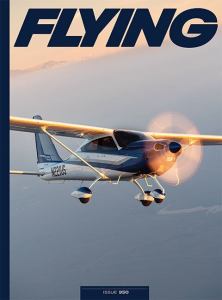
There are many active and former pilots who write and contribute content for FLYING. I am not one of them. Yet on June 3, I found myself at the controls of an all-electric aircraft.
The fly-by-wire controls of Beta Technologies’ Alia CX300 are intuitive enough that I—someone with zero flying experience—was able to take command from test pilot Chris “Pooter” Caputo for a few minutes without plummeting into Lake Champlain, next to the company’s facilities in Burlington, Vermont.
That was not on the agenda for Beta’s inaugural media day, during which the manufacturer welcomed reporters to its headquarters for the first time. I just happened to sit to Caputo’s left, next to one of the CX300’s two four-axis joysticks. The Alia is one of few electric models in development equipped with dual pilot controls for training.
The test flight was a highlight of Beta’s media day, which also included tours of the manufacturer’s research and production facilities and culminated in a formation flyby of its various aircraft. The CX300 is complemented by the company’s Alia A250, a vertical takeoff and landing (VTOL) variant, as well as the defense-oriented, hybrid-electric MV250. All three can be configured for passenger or cargo missions.
Here’s what I learned about the aircraft after taking a peak behind the curtain.
When Will Alia Arrive?
Beta is perhaps the most public-facing developer of advanced air mobility (AAM) aircraft.
Its CX300 has traversed the continental U.S. and Europe, flying under day, night, VFR, and IFR conditions. Last year, it flew into Hartsfield-Jackson Atlanta International Airport (KATL)—the busiest in the world—and was the opening flight demonstration at the Paris Air Show.
As of June, the company’s test fleet has collectively flown more than 140,000 nm. That month, the CX300 began demonstration flights in Hawaii. It will add to that with demonstrations at July’s Farnborough International Airshow in the U.K.
However, CEO Kyle Clark believes the media is selling the company short. Clark said the firm’s inaugural media day was intended to prove that, and he was adamant that its VTOL aircraft program, in particular, is just as advanced as competitors such as Joby Aviation or Archer Aviation.
Clark told FLYING that Beta would share firm figures on its VTOL flight testing. It has yet to do so as of this story’s publication.
Still, company officials said common components across the two Alia variants—including Beta’s H500A pusher motor, battery packs, flight control computers, and Hartzell’s Part 35 propellers—mean that once the conventional takeoff CX300 is certified, the FAA will credit about 80 percent of that work toward the VTOL A250’s certification.
Test articles for both models fly with FAA-certified electric pusher propellers, and Clark said he is “confident” that the H500A will be Part 33-certified before year’s end. He said CX300 certification will happen about one year after the H500A, with the A250 following about one year after that. This timeline places VTOL certification sometime in 2028.
Two Aircraft, One Core Design
Sean Donovan, Beta’s chief operating officer, led a tour of the company’s “South 40” manufacturing and assembly facility, where it plans to one day churn out hundreds of aircraft per year.
Occupying the 188,000-square-foot space were several active and retired Alia prototypes—identifiable by their four-wheel landing gear—and at least three production-intent models in various stages of assembly and testing. The CX300 and A250 are produced side by side on identical assembly lines, save for vertical takeoff boom and engine installations required for the latter.
“Structurally, that’s the one difference to the aircraft,” said Donovan. “Everything else is built on the same tools, using the same processes, following all the same procedures as the conventional aircraft, which is pretty awesome.”
The architecture is inspired by the Arctic tern—a ubiquitous image across Beta’s research and production facilities, often overlaid on Alia. The tern undertakes the longest annual migration of any bird species, flying tens of thousands of miles per year and more than 1 million over its lifespan. Alia’s 50-foot wingspan and 36-foot fuselage mirror the seabird’s wide reach relative to its size.
“It migrates all over the world on a meager diet,” said Adam Lowe, Alia flight operations lead. “We’re dealing with a meager diet of battery energy. We’ve gotta get this thing to fly far—how can we do that in a way that’s efficient and effective? And so looking at the bird for some design influences actually led into the design of the plane.”
According to Clark, Beta designed Alia without complex components—such as thrust vectoring or in-flight liquid cooling systems—to lower maintenance costs and simplify the company’s path to market.
He said the company’s internal calculations show a 40 percent reduction in operational costs per flight hour for the CX300 versus equivalent turbine aircraft, even accounting for pilot, insurance, and battery degradation costs. Chief financial officer Herman Cueto estimated the A250 would be 75 percent cheaper to operate than a helicopter. The company has not published a firm list price for either model.
Donovan said Beta’s H500A pusher and V600A vertical lift motors share fundamental elements, such as a magnetic rotor system that eliminates the need for a gearbox. The main difference is that the former is optimized for cruise efficiency, and the latter for weight to get the multi-thousand-pound A250 off the ground.
Both are split into distinct electrical segments that the company said provide the same redundancy as multiple engines. But it will need to certify them separately.
“We’ve got a single engine with a lot of the safety redundancies of a multi-engine, without any of the negative aerodynamic effects of having two engines mounted far out on the wings on separate sides, where if one fails, you’ve got this asymmetric thrust,” said Lowe. “Everyone that works on the plane and designs something on the plane needs to be confident enough that they can put a human in it and have it fly safely.”
Beta also produces electric battery packs at South 40. Nate Ward, who leads the company’s North American charging network, said its aircraft agnostic systems are installed at more than 60 U.S. airports. The CX300 and A250 use the same battery packs.
Lowe walked media members through Beta’s North Hangar research hub, adjacent to Patrick Leahy Burlington International Airport (KBVT), where completed aircraft head for a battery of tests. Engineers also use iron bird rigs, wing stress jigs, and other devices to push test articles to their limits.
“The whole goal of these tests is to break them and then learn from them, see if they meet their certification requirements,” Lowe said. “If they do, how can we continue to improve the design beyond that or optimize the design beyond that? And then if not, how can we improve the design to make sure it does meet the requirements?”
Future of Flight, or Present?
Before we hopped in the Alia CX300, Beta walked media members through the company’s pilot training program.
Members of Beta’s simulation team said test pilots and other employees—all of whom are offered free flight training on Alia and other aircraft—use one device to train on both variants. The only difference is that the VTOL cockpit has two additional switches that enable its four vertical lift motors.
“Whether or not they pursue a pilot’s license is not a factor,” Lowe said of Beta’s company-wide training. “It’s really just getting out there, getting in an aircraft, whether it’s a helicopter or an airplane, and experiencing that firsthand.”
In addition to the four-axis joystick and fly-by-wire system, Alia is controlled using a center console with a thumb dial to adjust speed. Garmin’s touchscreen G3000 Prime avionics suite displays key information such as altitude and battery life and allows the pilot to easily set a new heading. Crucially, the screens display available kilowatt-hours and real-time power consumption, allowing pilots to easily calculate how much energy they have remaining.
I got a firsthand look at the controls during my CX300 sortie. Air traffic controllers at the Burlington airport already know the aircraft well—they granted clearance to test pilot Caputo, and we subsequently accelerated and took off from Runway 33.
The Alia’s joystick controls roll and pitch, which Caputo demonstrated by banking about 30 degrees side to side. Shortly after, he cut the engine and allowed us to glide on the wing for a few moments. Then, Caputo caught me by surprise.
“Your controls,” he said.
I had flown a few simulators before, but never a real plane, and Caputo knew it. Yet after a few moments of initial terror, I quickly warmed up to Alia’s wildly simple controls.
Unsurprisingly, Caputo retook control for the approach and landing. But my brief time at the helm was evidence that Pipistrel’s Velis Electro—an increasingly common addition at U.S. flight schools—is not the only electric model mature enough for pilots to train on.
Later in the day, the passenger CX300 flew in formation next to an optionally piloted cargo variant and the A250. I watched the latter complete the transition from cruise to hover, the defining capability of VTOL aircraft, despite windy conditions. The aircraft were indeed quiet, though it is unclear if they were 10 times quieter than helicopters as Beta claims.
Pilots operating Republic Airways’ Brickyard Connection service have similarly tried out Alia. Beta and Republic conducted two recent test campaigns, one in subzero temperatures in the Northeast and another under Florida’s sweltering heat. According to Kristen Costello, who leads Beta’s government and regulatory affairs, pilots reported a 100 percent dispatch reliability rate.
That is “not enough sampling to get a real number, but it’s a pretty damn good indication that we have a reliable aircraft,” said Clark.
Beta is targeting CX300 certification next year followed by A250 certification in 2028. But readers could see the aircraft flying much sooner.
As early as September, by Clark’s estimate, Beta aims to conduct real-world operations with precertified Alia aircraft across at least 10 states. The FAA picked the company for seven projects under its eVTOL Integration Pilot Program (eIPP), which will last at least three years and see the new entrants fly into airports nationwide.
Clark said the eIPP “allows us to start service with customers,” such as Republic Airways, on their Part 135 tickets. That includes transporting cargo and medical equipment—and potentially even passengers—for revenue.
Costello said the goal is to begin “early commercial revenue operations” before either Alia variant is fully certified. That includes autonomous flights, she added.
“It’s cargo and logistics first, and then we will endeavor to get to passenger operations,” said Clark. “We’re ready to go today with cargo CTOL [conventional takeoff and landing] aircraft. Tomorrow, it’s gonna be passenger CTOL aircraft, then cargo VTOL aircraft, then passenger VTOL aircraft.”