Edwards Air Force Base (KEDW) has officially named the eight crewmembers who died in Monday’s B-52 Stratofortress crash, which was one of the most fatal in the model and base’s history.
Per a Wednesday afternoon update, the names were released following a mandated 24-hour waiting period to notify the victims’ next of kin.
“It is with profound sorrow and a heavy heart that I can now share the names of the eight extraordinary Americans we lost during Monday’s B-52 crash,” said Colonel Thomas Tauer, commander of the 412th Test Wing at Edwards. “They were dedicated professionals, beloved family members, and irreplaceable teammates.”
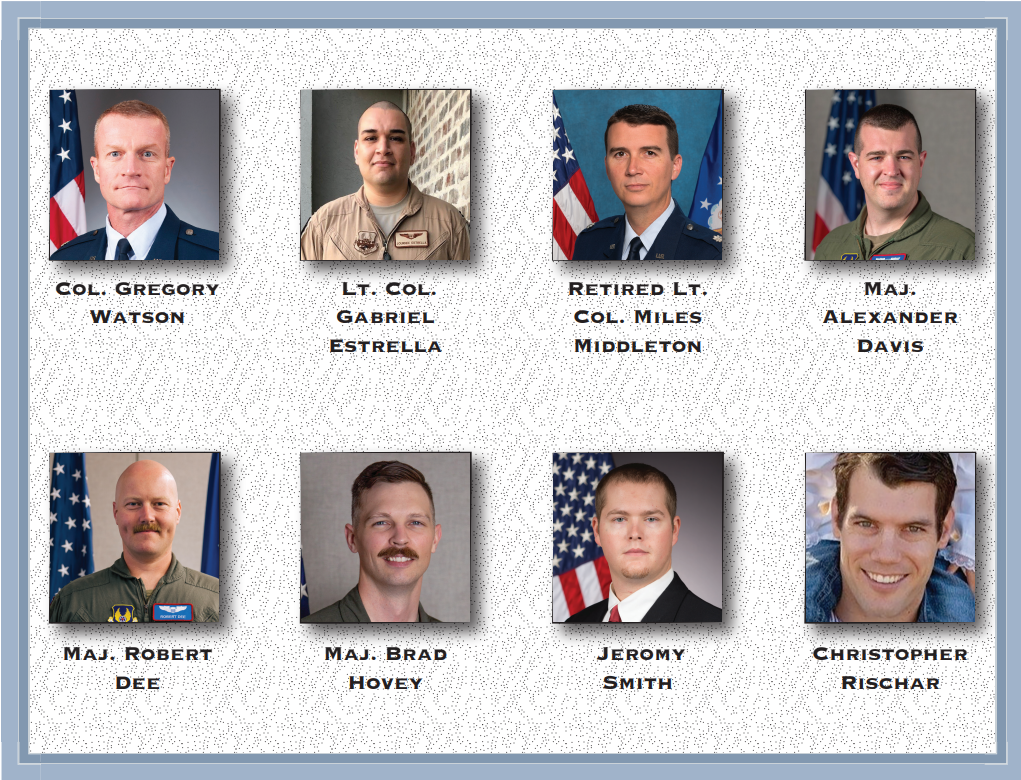
The eight people who died in the crash are:
- Colonel Gregory Watson, 53, a weapon systems officer for Boeing and U.S. Air Force reservist assigned to Naval Air Station Joint Reserve Base Fort Worth (KNFW) in Texas.
- Lieutenant Colonel Gabriel Estrella, 40, a weapon systems officer for the Air Force Operational Test and Evaluation Center’s Detachment 5 at Edwards.
- Retired Lieutenant Colonel Miles Middleton, 50, a pilot for Boeing.
- Major Alexander Davis, 34, a weapon systems officer for the 419th Flight Test Squadron in Lancaster, California.
- Major Robert Dee, 40, a pilot for the 419th at Edwards.
- Major Brad Hovey, 35, a pilot for the 419th at Edwards.
- Jeromy Smith, 32, a flight test engineer for the 419th in Rosamund, California.
- Christopher Rischar, 41, a flight test engineer for Pentagon contractor JT4 in Lancaster, California.
“These airmen were more than coworkers. They were friends, mentors, teammates and valued members of our Edwards and Air Force family,” Tauer said. “Our immediate focus is supporting the families of the teammates we lost and ensuring that all appropriate resources are available to them during this time of unimaginable loss.”
On Tuesday, the 412th Test Wing opened an Emergency Family Assistance Center (EFAC). For people with base access to Edwards, the EFAC will offer mental health, childcare, and legal services until further notice.
The base expects to resume flight test activities next week, but the airfield will remain closed until at least Thursday as crews continue to clear the runway.
Investigation Opens
Some family members identified their loved ones as casualties of the B-52 crash before the 412th Test Wing’s announcement.
The family of Miles Middleton, the 50-year-old Boeing pilot, earlier Wednesday told NBC4 Los Angeles that he is survived by his wife of 25 years and two children.
“If he was in the seat, he did everything in his power to save that flight,” Middleton’s wife Pamela Helfrich told NBC4, though she was unsure whether Middleton was flying.
The Air Force veteran served in Afghanistan and had a decorated military career, his family said.
Lauren Smith, the wife of 419th Flight Test Squadron flight test engineer Jeromy Smith, on Tuesday told KTLA-5 that, according to her husband, “something was wrong with the plane” before Monday’s flight.
“I don’t know what was wrong, but the flight kept getting pushed back,” Smith said. “[Jeromy] was supposed to fly in the morning, and then it got pushed back to noon and then it got pushed back to 2 o’clock. And then they said they’re going to have to fix whatever was wrong with it and that they would fly when it was done.”
According to a GoFundMe page created for Lauren Smith’s family, Jeromy is also survived by two young children.
The B-52 has six crew positions and four jump seats but typically flies with five. Officials said Monday that the aircraft was conducting testing for the military’s B-52 Radar Modernization Program, which aims to keep its oldest strategic bomber fleet flying through the 2050s. It flew straight and crashed on the runway around 11:20 a.m. PDT, per flight tracking data.
A combined test force within the 419th Flight Test Squadron, also stationed at Edwards, was leading this specific flight, a public affairs spokesperson for the 412th Test Wing said Tuesday evening. They described the combined test force as a unique framework within Edwards that comprises active-duty military personnel, government civilians, and contractors working hand in hand.
The spokesperson said that an accident investigation board process is now formally underway, estimating it would take six months to make initial conclusions. Concurrently, an interim safety investigation board is analyzing initial evidence in order to determine root causes of the tragedy. The safety investigation board is expected to share findings only with Defense Department personnel in the next 30 days. The accident investigation board will share conclusions publicly.
“At this point, we don’t have any indication as to what the cause was of this,” Air Force Colonel James Hayes, deputy commander of the 412th Test Wing, said in a news conference on Monday. “We won’t be able to release that information, and we don’t have an availability to get that anytime soon.”
The B-52 entered service in the 1950s and is one of the oldest aircraft still flown by the military. Fatal accidents were far more common in the model’s early decades of operation but have become increasingly rare. Before Monday, the last fatal B-52 crash was in 2008, killing six off the coast of Guam.
Heather Penney, a former F-16 combat pilot who spoke to The Associated Press, said pilot error is an unlikely cause of the crash. Other experts interviewed by AP emphasized that while it is too early to draw conclusions, investigators may consider a malfunction in one of the aircraft’s engines or systems.
The B-52 has a two-level cockpit, requiring downward ejection seats for some crew stations. If the aircraft suffered an anomaly at low altitude, ejecting may have been impossible or fatal for the occupants.